
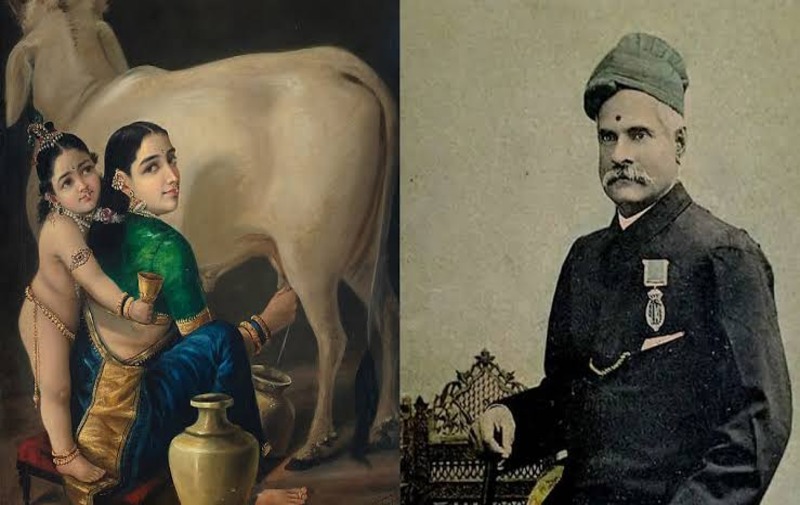
This 1890s Painting Just Sold for ₹167 Cr—and the Story Will Melt Your Heart
In a landmark moment that has stirred both pride and emotion across the country, the iconic painting Yashoda and Krishna by Raja Ravi Varma has created history. Sold for a staggering ₹167.2 crore at a Saffronart auction in Mumbai, the masterpiece is now the most expensive Indian artwork ever sold. But beyond the numbers, beyond the auction halls and bidding wars, lies something far more powerful a story of love, culture, and identity that belongs to every Indian heart. The Painting That Captured a Mother’s LovePainted in the 1890s, at the peak of Ravi Varma’s career, Yashoda and Krishna is not just a visual—it is a feeling. The scene is simple yet deeply moving. Yashoda, the foster mother of Lord Krishna, is seen milking a cow in a serene, pastoral setting. Behind her, the young Krishna quietly approaches, reaching out for a goblet of milk innocent, playful, and full of love. There is no grandeur, no dramatic action. Just a tender, everyday moment between a mother and her child. And perhaps that is what makes it immortal. In that single frame, Ravi Varma captured something universal: motherhood. A bond that transcends time, culture, and even mythology.Image Source : The Hindu Breaking Records, Setting New BenchmarksThe historic sale has now surpassed the previous record held by Untitled (Gram Yatra) by M. F. Husain, which had crossed ₹118 crore. This is not just a financial milestone; it is a powerful statement about the growing recognition of Indian art on the global stage. As Minal Vazirani, co-founder of Saffronart, beautifully said, great art always finds a way to reaffirm its timeless value. And this sale proves exactly that. Because some creations are not bound by time. They only grow more meaningful with it.From Canvas to Culture: The Legacy of Ravi VarmaTo understand the magnitude of this moment, one must understand the man behind the masterpiece. Raja Ravi Varma is often called the “Father of Modern Indian Art,” and rightly so. Born in 1848 in Kerala, he revolutionised Indian art by blending European painting techniques with Indian themes, mythology, and culture. He didn’t just paint gods and goddesses; he made them human. Relatable. Real. Through his work, figures from the Mahabharata and Puranas stepped out of scriptures and into everyday life. His lithographs made art accessible to common people, allowing even ordinary households to own and connect with divine imagery. In many ways, Ravi Varma shaped how generations of Indians imagine their gods.More Than a Painting: A National TreasureWhat makes Yashoda and Krishna truly special is its emotional depth. It is not just about mythology. It is about memories. For many Indians, the image of Krishna is tied to childhood stories told by grandparents. The image of Yashoda reminds us of unconditional love, the kind that expects nothing in return. This painting brings all those emotions together. And perhaps that is why industrialist Cyrus Poonawalla, who acquired the artwork, called it a “national treasure” and expressed his desire to make it available for public viewing. Because some art should not be locked away. It should be shared.A Journey Through TimeThe painting’s history is as fascinating as its present. Its earliest recorded mention dates back to 1911, when it appeared in a publication titled Half-Tone Reprints of the Renowned Pictures of the Late Raja Ravi Varma by S. N. Joshi, where it was called Milching a Cow. Later, it was reproduced as a chromolithograph at the Ravi Varma Press under the title we know today. Over the decades, it quietly travelled through time admired, preserved, and cherished—until it finally returned to the spotlight in the most spectacular way possible. It reminds us of home. Of a mother calling us for food. Of small childhood moments we often forget. Of love that is simple, pure, and unconditional. In a world that is constantly rushing forward, this painting asks us to pause. To feel. To remember. To reconnect. Because at its heart, it is not just about Yashoda and Krishna. It is about all of us.When Art Becomes EternalAs the gavel fell at the auction and the final price was announced, it marked more than just the end of a sale. It marked the beginning of a new chapter, one where Indian art stands taller, shines brighter, and reaches further than ever before. Because true art does not fade.It does not age. It lives on in hearts, in memories, and sometimes, in moments that make history. And Yashoda and Krishna is one such moment.