
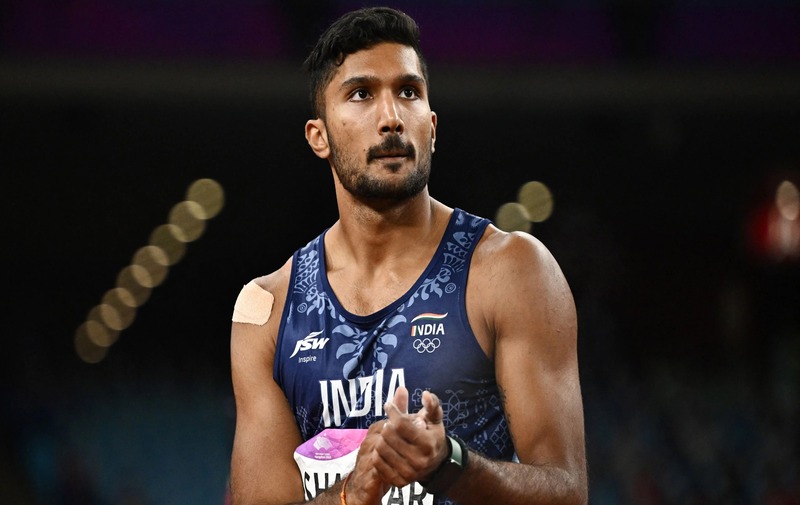
One Gold That Mattered Most: Tejaswin Shankar Shines in Tianjin
Sometimes, a championship isn’t remembered for how many medals a country wins, but for who stood tall when it mattered most. At the Asian Indoor Athletics Championships 2026 in Tianjin, India finished sixth on the medal table with five medals. But amid the numbers and standings, one performance rose above everything else: Tejaswin Shankar’s golden heptathlon that turned an entire campaign into a moment of pride. With calm control, physical dominance, and quiet resilience, Shankar delivered India’s only gold medal of the championships, breaking his own national record.India’s Campaign: Fewer Golds, Stronger SignalsIndia wrapped up its campaign with one gold, two silvers, and two bronzes. While China dominated the championships with a massive 34-medal haul, including 10 golds, India’s athletes showed depth and promise across disciplines. Pooja’s silver in the women’s high jump with a leap of 1.87 metres reflected consistency in India’s jumping events. Tajinderpal Singh Toor came agonisingly close to gold in the men’s shot put, settling for silver with a season-best throw of 20.05 metres. Ancy Sojan added a bronze in the women’s long jump, while Aadrash Ram Jothi Shankar secured bronze in the high jump earlier in the meet. Yet, above all these efforts stood Tejaswin Shankar, a multi-event athlete who didn’t just win but dominated.A Golden Heptathlon That Redefined RecordsLeading from the very first day, Tejaswin Shankar entered the final day of the heptathlon with 3513 points, already in command of the field. What followed was not a defensive performance but an emphatic statement. He began the final day by clocking 8.02 seconds in the 60m hurdles, earning a crucial 977 points. In the pole vault, he cleared 4.20 metres, adding 673 points with confidence. Then came the ultimate test: the 1000 m race. Digging deep, Shankar finished in 2:43.91, pushing his total to an extraordinary 5993 points. That number meant everything. It shattered his own national indoor record of 5650 points set in 2021. It became a championship record. And it stood as the second-best heptathlon score ever achieved by an Asian athlete. Most importantly, it delivered India’s only gold medal of the championships.Heptathlon ExplainedThe heptathlon is a combined athletics event where an athlete competes in seven different track and field disciplines, testing speed, strength, skill, and endurance. In the indoor heptathlon for men, the events are the 60m sprint, long jump, shot put, high jump, 60m hurdles, pole vault, and 1000m race. Each performance earns points based on international scoring tables, and the athlete with the highest total score wins. The heptathlon is considered one of the toughest events in athletics because it demands versatility, consistency, and all-round athletic excellence. Tejaswin Shankar’s gold was more than personal glory. It ended India’s 16-year wait for a heptathlon medal at the Asian Indoor Athletics Championships. The last Indian to stand on the podium in the event was PJ Vinod, who won bronze in 2010. In Tianjin, Shankar didn’t just return India to the podium; he placed the country right at the top.From High Jump Prodigy to Multi-Event MasterBorn on 21 December 1998 in Saket, New Delhi, Tejaswin Shankar’s journey has never followed a straight line. A cricketer until eighth grade, he switched to high jump on the advice of a school physical education teacher—a decision that would change his life. He rose rapidly, breaking national records as a teenager and becoming India’s third-best junior high jumper globally in 2016. Injuries followed, including a slipped disc that left him bedridden for six months in 2017. But Shankar responded the only way he knows how—by evolving. From NCAA Division I titles in high jump to India’s first-ever Commonwealth Games high jump medal in 2022, and later a bold switch to decathlon, Shankar has repeatedly chosen the harder path. His silver at the Asian Games and medals at the Asian Championships only hinted at his potential. Tianjin confirmed it.What This Gold Truly Means for IndiaTejaswin Shankar’s gold at the Asian Indoor Athletics Championships 2026 is not just a medal; it is a signal. A signal that Indian athletics is learning to win complex, demanding events. A signal that resilience, reinvention, and patience still matter in modern sport. As India looks ahead to bigger global stages, performances like this offer belief. And in Tianjin, with one man carrying the weight of expectation and delivering under pressure, Indian athletics found its brightest moment wrapped in gold.