
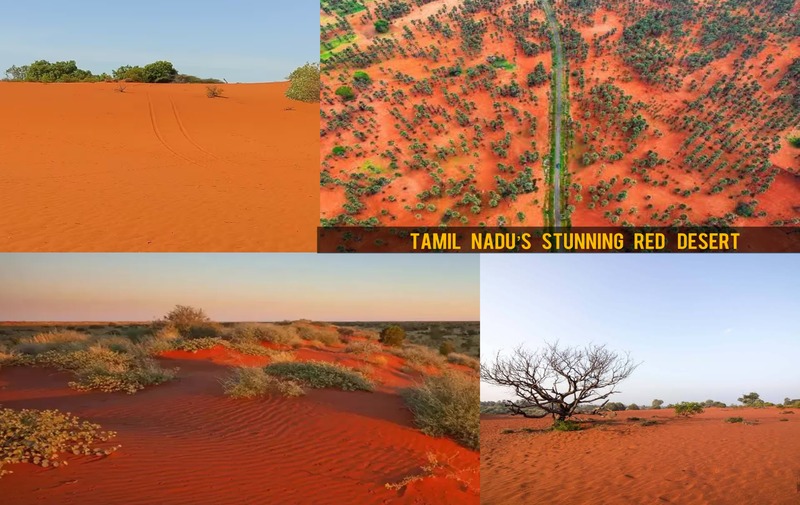
Why Theri Kaadu Is India’s Most Unexpected Natural Wonder
When people imagine deserts in India, their minds instantly jump to Rajasthan’s golden Thar. But deep in Tamil Nadu, far away from the usual desert landscapes, lies a hidden marvel few Indians know about: Theri Kaadu, a mysterious stretch of red sand that looks strikingly like the surface of Mars. Spread across the districts of Thoothukudi and Tirunelveli, this 500 sq km landscape is one of India’s most unusual natural wonders.A Martian Landscape on Indian SoilThe first thing that captures any visitor’s eye is the incredible crimson color of the sand. Unlike the yellow or white sands seen in most deserts and beaches, Theri Kaadu glows in shades of fiery red and burnt orange. This unusual color comes from the high iron oxide content in the soil, the same mineral responsible for Mars’ iconic red appearance. Standing atop these dunes during sunset, with the red sand glowing under the fading light, it becomes easy to understand why locals fondly call it “the Mars of Tamil Nadu.”A Natural Wonder Born from Ancient SeasThe story of Theri Kaadu began not years, not centuries, but thousands of years ago, during the Quaternary Period. At that time, the region looked very different. During the Last Glacial Maximum, around 10,000 years ago, sea levels were much lower. Huge parts of the seafloor were exposed. As explained by Dr. Christy Nirmala Mary, Head of Soil & Environment Studies at the Agricultural College and Research Institute, Madurai, strong winds swept across this exposed sea shelf and the Western Ghats, carrying iron-rich sediments to the southeastern coast of Tamil Nadu. Over thousands of years, these sediments settled, accumulated, and evolved, forming the dramatic red dunes we now know as Theri Kaadu. In other words, what you see today is not just sand; it is a living memory of ancient oceans, shifting winds, and the Earth’s changing climate.Theri Kaadu Is Not a Typical DesertAlthough Theri Kaadu feels like a desert, it is scientifically unique. It was not formed because of prolonged dryness like the Sahara or Thar. Instead, it is a result of wind-driven (aeolian) processes and ancient marine deposits coming together in a rare geological combination. Theri Kaadu literally means “red dune forest.” In many parts, scrub forests, hardy shrubs, and natural vegetation grow on and around the dunes—a reminder that life can thrive even in harsh conditions.Three Types of Red DunesDespite being smaller than major deserts, Theri Kaadu has surprising geological variety. Its red dunes change in character as you move closer to the sea. Inland terraces, found farthest from the coast, are the most stable because plants and roots have held them in place over many years. Moving slightly closer to the shoreline, the Close-to-Coastal Theris begin to shift gently, influenced by natural winds and human activities. Finally, right next to the sea lie the Coastal Theris, the most active dunes of all. Here, strong southwest winds keep the sand constantly on the move, creating a landscape that changes shape almost every year. Walking through these dunes feels like exploring a living, breathing Earth that reshapes itself with every season.Theri Kaadu: A Window into the Earth’s HistoryTheri Kaadu is much more than a red sandy patch in Tamil Nadu. It is a geological archive, preserving thousands of years of climatic shifts, sea-level changes, and wind patterns. Scientists study its sand grains to understand ancient environments, while travelers come to experience a landscape that feels otherworldly. Most of all, Theri Kaadu stands as a quiet message from the past, telling us how dynamic, powerful, and ever-changing our planet truly is. For curious travellers, geology lovers, and anyone who enjoys nature’s surprises, Theri Kaadu is a place worth discovering. It shows us that India still holds secrets, and some of them shine the color of fire.