
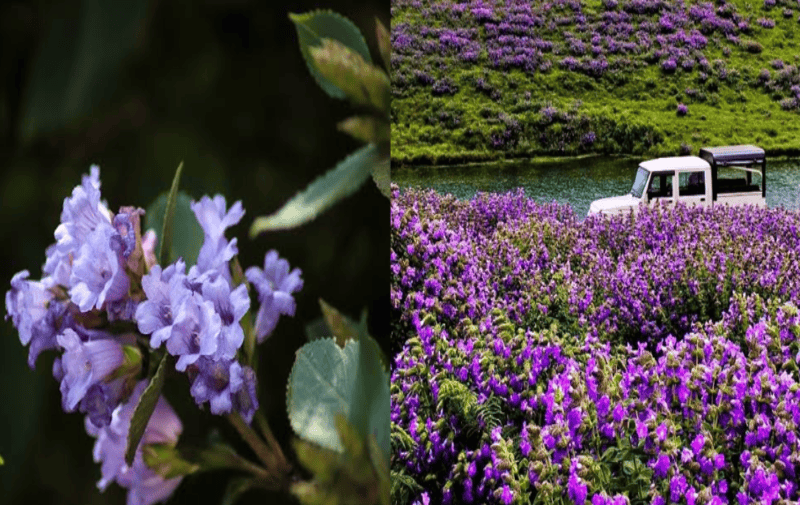
Munnar Turns Purple! The Flower That Blooms Once Every 12 Years Has Everyone Talking
There is something magical about a flower that refuses to hurry. For nearly 12 years, the Neelakurinji grows quietly across the highlands of the Western Ghats. Then, almost as if following nature’s own calendar, it bursts into bloom and transforms the hills into a breathtaking carpet of blue-violet.That rare spectacle is now unfolding around Munnar.Large stretches of the Korandakkad and Chokramudi hills near Mattupetty have begun flowering, with the season starting in August. The Chokramudi area was opened to visitors on August 24, according to an ANI report. And as September progresses, forest officials expect the bloom to spread further across the higher slopes, including parts of Meesapulimala.But What About 2030?The sight has sparked an intriguing question: If Neelakurinji is blooming in 2026, has the famous 2030 bloom arrived four years early? Not quite. The answer lies in the flower’s remarkable biology and the fact that different Neelakurinji populations follow different clocks.The Times of India reports that the Chokramudi and Mattupetty population last flowered in 2014. That makes 2026 its expected flowering year. Meanwhile, the population at Eravikulam National Park, which is closely associated with Munnar’s famous Neelakurinji tourism season, last experienced a major bloom in 2018. Its next expected flowering is around 2030. So, Nature simply has different schedules for different hills.Neelakurinji, scientifically known as Strobilanthes kunthiana, has one of nature’s most fascinating survival strategies. Entire populations can flower together after roughly 12 years. The plants bloom, produce seeds and die. The next generation then grows for years before the cycle begins again.That extraordinary rhythm is what makes a Neelakurinji season so eagerly awaited.Beauty That Needs ProtectionBehind the spectacular purple landscape is also a conservation story. The high-altitude shola-grassland habitat where Neelakurinji grows faces pressure from plantation expansion, urbanisation, invasive species and tourism. The species was assessed for the first time for the IUCN Red List in 2024 and classified as Vulnerable, highlighting the need to protect its shrinking habitat.Industrialist Harsh Goenka also recently shared a glimpse of the spectacular bloom, describing it as a sight worth waiting years to witness. For now, Munnar’s hills are putting on a show that nature has been preparing for more than a decade. And if you miss this one, the next chance may take years.