
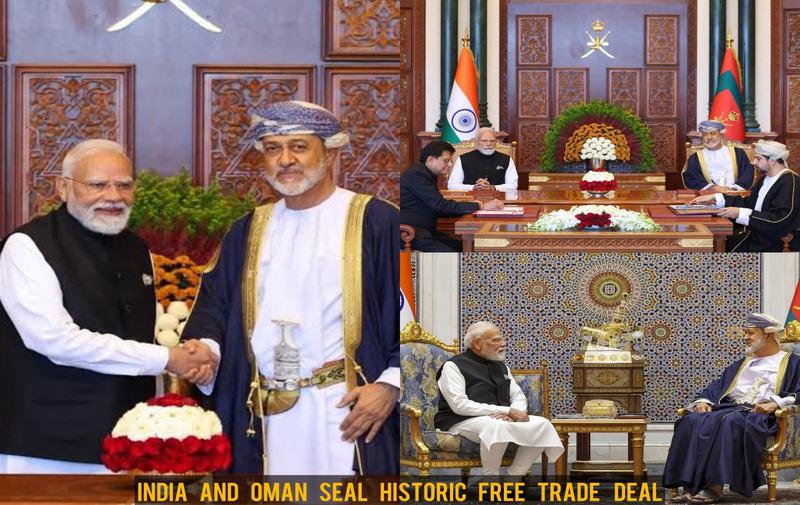
India and Oman Sign Landmark Trade Pact, Unlocking New Export Opportunities
India and Oman have taken a decisive step towards deepening their economic partnership with the signing of a Comprehensive Economic Partnership Agreement (CEPA) on December 18, 2025. The agreement, signed in Muscat by Union Commerce and Industry Minister Piyush Goyal and Oman’s Minister of Commerce, Industry and Investment Promotion Qais bin Mohammed Al Yousef, was witnessed by Prime Minister Narendra Modi and Sultan Haitham bin Tarik. More than just a trade pact, the CEPA reflects growing trust, strategic alignment, and people-to-people ties between the two nations. At its core, the agreement aims to remove barriers to trade, boost services cooperation, and create new pathways for investment and employment. For Indian exporters, professionals, and entrepreneurs, the deal opens doors that were previously constrained by tariffs and restrictive mobility norms.Near-Total Tariff-Free Access for Indian ExportsOne of the most significant outcomes of the CEPA is Oman’s decision to provide India duty-free access to 98.08 percent of its tariff lines. This effectively covers 99.38 percent of India’s exports to Oman, offering a major competitive advantage to Indian goods in the Omani market. On the other side, India has agreed to liberalize tariffs on 77.79 percent of its tariff lines, covering 94.81 percent of imports from Oman. In 2024–25, India exported goods worth USD 4.06 billion to Oman, while imports stood at USD 6.5 billion. Although Oman accounts for less than 1 percent of India’s total trade, the strategic importance of the Gulf nation lies in its location, energy resources, and long-standing ties with India. With tariffs of around 5 percent currently applied on nearly 83.5 percent of Indian exports to Oman, the removal of these duties could significantly improve margins for Indian exporters.Relief for Key Export SectorsIndia’s exports to Oman are currently dominated by petroleum products, which already enjoy relatively low duties. However, the real gains from CEPA are expected in sectors that previously faced tariffs. Engineering goods, chemicals, textiles, and minerals such as mica and coal are among the major beneficiaries. Labor-intensive sectors like ready-made garments, which face growing tariff pressures in Western markets such as the US, are likely to find Oman a more attractive destination. In FY25 alone, India exported ready-made garments worth USH 63.8 million to Oman. For textile workers and small manufacturers in India, tariff elimination could mean more stable orders, better prices, and sustained employment. This is where the human impact of the agreement becomes visible, moving beyond macroeconomic numbers to livelihoods on the ground.A Major Boost for India’s Services SectorBeyond goods, the CEPA places strong emphasis on services, an area where India holds a natural advantage. Oman has made wide-ranging commitments across sectors such as computer-related services, professional and business services, education, healthcare, research and development, and audio-visual services. With Oman importing services worth USD12.52 billion globally, and India currently holding just over 5 percent of that share, there is ample room for expansion. The agreement also allows 100 percent foreign direct investment by Indian companies in major services sectors in Oman through commercial presence. This opens the door for Indian IT firms, healthcare providers, educational institutions, and consulting companies to establish long-term operations in the Gulf nation.Enhanced Mobility and Opportunities for ProfessionalsPerhaps the most human-centric aspect of the CEPA is the enhanced mobility framework for Indian professionals. For the first time, Oman has offered extensive commitments under Mode 4, which governs the movement of natural persons. The quota for intra-corporate transferees has been increased from 20 percent to 50 percent, while the permitted stay for contractual service suppliers has been extended from 90 days to two years, with the option of a further two-year extension. Additionally, more liberal entry and stay conditions have been offered for skilled professionals in fields such as accountancy, taxation, architecture, and medical services. For Indian professionals and their families, this means greater job security, longer-term planning, and deeper integration into the Omani economy.Part of a Larger Gulf StrategyThe India–Oman CEPA is India’s second major trade agreement with a Gulf nation, following the CEPA with the United Arab Emirates in 2022. Together, these agreements signal India’s intent to strengthen economic integration with the Gulf Cooperation Council region. Negotiations with Oman began in November 2023 and concluded in August 2025 after multiple rounds of discussions. The relatively swift conclusion reflects strong political will on both sides and a shared vision of economic partnership.More Than a Trade DealWhile the CEPA is packed with technical details on tariffs and services, its real significance lies in the opportunities it creates for people. From an Indian textile worker benefiting from new export orders to a young IT professional securing a long-term assignment in Muscat, the agreement touches lives in tangible ways. It also reinforces the centuries-old cultural and commercial ties between India and Oman, adapting them to the demands of a modern global economy. In essence, the India–Oman CEPA is not just about trade figures crossing USD 3 billion without tariffs. It is about trust, opportunity, and shared growth, laying the foundation for a stronger, more connected future between the two nations.