
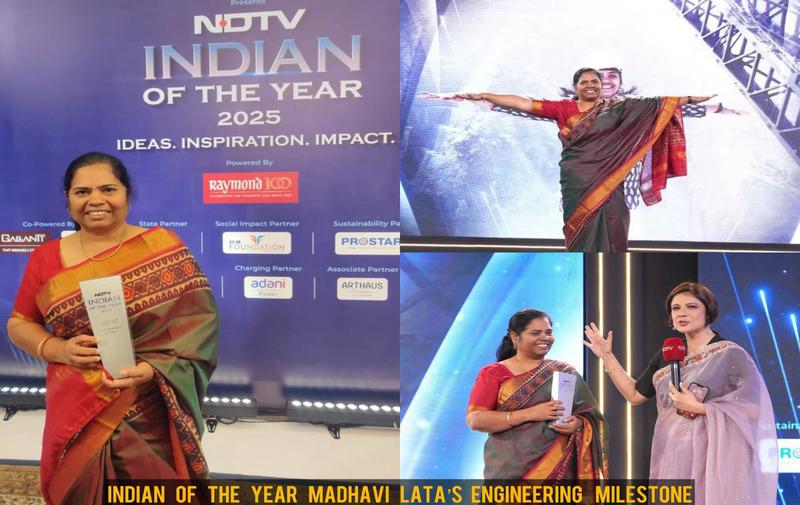
Professor Madhavi Latha: Honored as Indian of the Year, Remembered for Building the Impossible!
Professor Madhavi Latha was honored as the co-winner of the Indian Science Icon of the Year at the NDTV Indian of the Year event. Her journey, from a barefoot girl in a remote Andhra village to a celebrated scientist, is both inspiring and extraordinary. Born in Yedugundlapadu, a small village, Madhavi faced extreme poverty early in life. Her father, a farmer, lost his fortunes when she was ten, leaving the family struggling to make ends meet. She recalls selling old notebooks for 40 paise just to buy kerosene for cooking. This childhood hardship shaped her determination to pursue education and make a lasting impact on society.Breaking Barriers in EducationAt the age of 16, Madhavi joined Jawaharlal Nehru Technological University, Kakinada, for a B.Tech in civil engineering, becoming the first engineer from her village. Despite initial struggles with hostel life and cultural adjustments, she persevered, guided by the encouragement of her grandmother. Madhavi went on to earn an M.Tech from NIT Warangal and a PhD from IIT Madras. Her academic journey led her to the Indian Institute of Science (IISc), Bengaluru, where she became the first woman faculty member in the 53-year-old Civil Engineering Department. Today, she heads the Centre for Sustainable Technologies at IISc and serves as editor-in-chief of the Indian Geotechnical Journal.The Chenab Railway Bridge: An Engineering MarvelMadhavi Latha played a pioneering role in one of India’s most ambitious infrastructure projects: the Chenab Railway Bridge in Jammu and Kashmir. Soaring 359 meters above the Chenab River, the bridge is the highest railway bridge in the world, taller than the Eiffel Tower by 35 meters. As part of the Udhampur-Srinagar-Baramulla Rail Link (USBRL), it connects Kashmir to the rest of India, fulfilling a century-old dream. This bridge is not merely a transport link; it symbolizes the unity of the nation, with the Vande Bharat train now able to traverse from Kashmir to Kanyakumari.Challenges on the Himalayan SlopesConstructing the Chenab Bridge was a feat of engineering, with challenges unlike any other. The Himalayan slopes were unstable, prone to landslides, and inaccessible. The region’s high seismic vulnerability and harsh weather further complicated construction. Madhavi Latha recalls her first visit to the site in 2005, when no human footsteps had marked the slopes. She and her team had to navigate treacherous terrain by boat and climb hills where landslides could strike at any moment.Role of a Geotechnical ExpertAs a geotechnical consultant, Madhavi’s work was critical in ensuring the safety and stability of the bridge. She designed slope stabilization strategies and foundation systems and monitored construction over 17 years. The bridge’s arch spans two steep hills without intermediate support, demanding precision in every calculation to withstand earthquakes, landslides, and extreme wind speeds of up to 220 km/h. Her expertise in earthquake geotechnical engineering and rock mechanics proved indispensable. Madhavi often worked around the clock, sometimes three days without sleep, fully dedicating herself to the project.Madhavi Latha Honoured as Science Icon of the YearBeing named the Science Icon of the Year at the NDTV Indian of the Year event is a recognition of exceptional contribution to science and engineering. For Professor Madhavi Latha, this accolade celebrates her pioneering role in building the Chenab Railway Bridge, the world’s highest railway bridge, and highlights her decades of dedication to geotechnical engineering. The award underscores her influence not just as a scientist but as a mentor shaping future engineers. It stands as a powerful example of perseverance, innovation, and leadership, inspiring countless young minds to pursue science and create transformative infrastructure for India.