
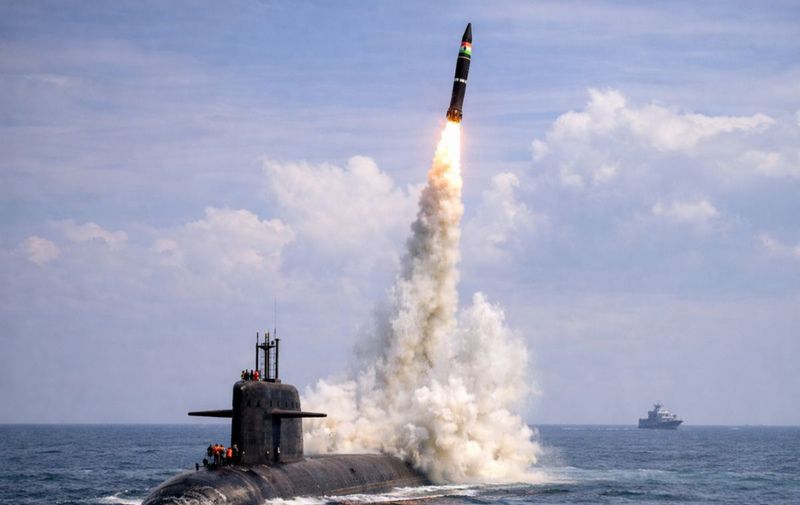
India Successfully Tests K-4 Missile from INS Arighaat: Underwater Nuclear Strike Capability Gets a Boost
India took a decisive step in reinforcing its nuclear deterrence framework with the successful test-firing of the K-4 submarine-launched ballistic missile (SLBM) from the nuclear-powered ballistic missile submarine INS Arighaat. Conducted in the Bay of Bengal off the coast of Visakhapatnam, the test marked the first reported launch of the K-4 missile from this platform. More than a routine weapons trial, the event signalled India’s growing confidence in the survivability and maturity of its sea-based nuclear strike capability. The successful launch strengthens the most resilient leg of India’s nuclear triad and underscores the country’s commitment to maintaining credible minimum deterrence in a complex and volatile regional security environment.The K-4 Missile: Extending India’s Strategic ReachThe K-4 is a solid-fuel, two-stage, nuclear-capable submarine-launched ballistic missile with a range of approximately 3,500 kilometres. Designed specifically for deployment on Arihant-class nuclear submarines, it represents a significant technological and doctrinal advance over India’s earlier sea-based missile, the K-15. Capable of carrying a nuclear payload of roughly two tonnes, the K-4 offers greater range, flexibility, and survivability. Its solid-fuel design makes it well-suited for submarine operations, allowing the missile to remain stored for long durations and be launched rapidly with minimal crew exposure. This compatibility with vertical launch systems is critical for deterrent patrols, where stealth, readiness, and reliability are paramount.Why Range Matters in Undersea DeterrenceThe difference between the K-4 and the shorter-range K-15 is not merely technical; it is strategic. The K-15, with a range of about 700 to 750 kilometers, requires Indian submarines to patrol closer to adversary coastlines in order to hold key targets at risk. Operating in such waters increases vulnerability to enemy anti-submarine warfare systems. The 3,500-kilometer reach of the K-4 dramatically expands safe patrol zones. Indian ballistic missile submarines can now operate farther from hostile shores, in waters where India has better control through maritime patrol aircraft, surface escorts, and emerging undersea surveillance capabilities. This extended reach enhances the probability that at least one submarine would survive a first strike and remain capable of executing a retaliatory response.INS Arighaat and the Maturing Arihant ClassThe platform from which the missile was launched, INS Arighaat, is central to this achievement. Arighaat is the second operational ballistic missile submarine of the Arihant class. Compared to the lead boat INS Arihant, Arighaat incorporates design refinements and reflects deeper indigenous industrial integration, highlighting India’s growing self-reliance in complex strategic technologies. Operating under the Strategic Forces Command, INS Arighaat is not merely a naval asset but a national strategic instrument. Its successful integration with the K-4 missile transforms the Arihant class from a limited deterrent capability into a far more survivable and flexible second-strike force.Regional Security and Strategic StabilityIndia’s continued investment in sea-based deterrence is shaped by its regional security environment. With two nuclear-armed neighbors and a history of crisis dynamics in South Asia, the risk of escalation, intentional or accidental, remains ever-present. Even limited conventional confrontations tend to draw international concern over potential nuclear implications. Against this backdrop, India positions its deterrence strategy as stabilizing rather than aggressive. The logic is clear: credible, survivable retaliatory forces reduce incentives for coercion or miscalculation. The K-4 test reinforces this logic by making India’s second-strike capability more reliable and less vulnerable. The K-4 launch is part of a broader, long-term force development trajectory. India plans to induct additional ballistic missile submarines, including INS Aridhaman, expected to join the fleet in the near future. Follow-on submarines with greater endurance and missile capacity are also under development.Beyond Technology: A National EndeavourBehind the missile and the submarine lies a quiet human story of scientists, engineers, naval crews, and strategists who have worked for decades to build a survivable deterrent almost entirely through indigenous effort. For the sailors aboard INS Arighaat, the successful test was not just a technical validation but a moment of pride, reflecting countless hours of training, discipline, and trust in complex systems deep beneath the sea. The significance of the K-4 test lies not in a single launch, but in what it represents: India’s steady, deliberate move toward a more secure and stable deterrence posture. It marks a transformation of intent into capability, aligning advanced technology with national doctrine and long-term security calculations. In the silent depths of the Bay of Bengal, India’s message was clear—its second-strike capability is growing stronger, more survivable, and firmly rooted beneath the waves.