
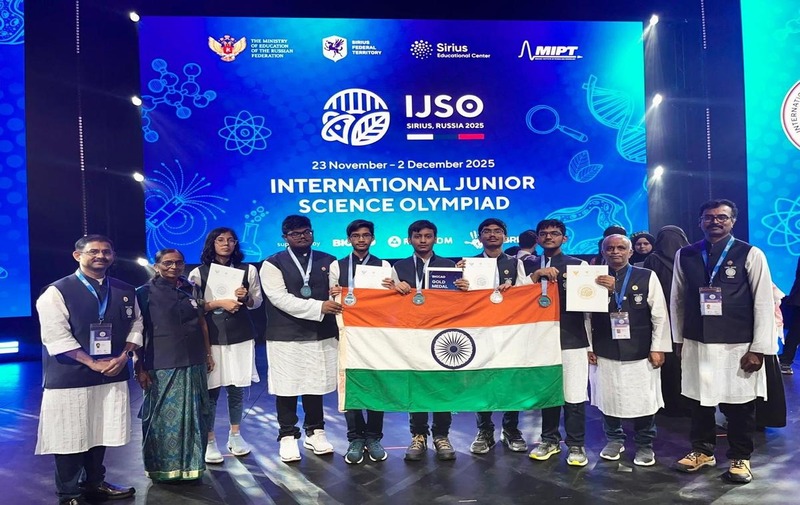
Gold, Silver, and a Whole Lot of Brainpower: India Rocks at the International Junior Science Olympiad 2025
India has once again proved its strength in science education by winning two gold and four silver medals at the 22nd International Junior Science Olympiad (IJSO 2025). The competition was held in Sirius, Russia, from November 22 to December 1, 2025, and saw participation from twenty-four countries. With nearly 140 of the brightest young students from around the world competing, India’s performance stood out as both inspiring and emotional. This year’s Indian contingent consisted of six students, all selected through a rigorous, multi-stage national process that tested both knowledge and endurance.Celebrating India’s Medal WinnersAadish Jain from Haryana and Anmol Kumar from Punjab emerged as the gold medallists for India. Their achievement reflects countless hours of study, preparation, and commitment to science. For students of their age, competing at an international platform is not just about winning a medal but about experiencing the joy of representing the nation. Standing on the podium with the Indian flag behind them is a moment that becomes a lifelong memory. The silver medallists include Asmi Inamdar from Maharashtra, Sai Sravan Muvvala from Telangana, Ruhan Mohanty from Bhubaneswar, and Tejas S. V. from Tamil Nadu. Each of them completed the competition’s tough challenges and proved their deep understanding of physics, chemistry, and biology. These medals symbolize their perseverance and the emotional support of their families and teachers.The Academic Journey of the TeamFor the young students, the journey to IJSO is not just academic but deeply personal. Many of them began preparing for Olympiads long before the formal process started. Their families watched them spend nights studying, solving problems, and balancing schoolwork with their passion for science. These young achievers faced enormous pressure, yet they continued with determination, knowing that they were working toward representing India on a global platform. The team was guided by three respected leaders: Shirish Pathare, a scientist from HBCSE, TIFR; Prof. Vedavyasa, retired professor from St. Joseph’s College; and Aravinda S from TDC, IISc Challakere. Scientific Observer Geetha R. S, a retired professor from Vijaya College, Bangalore, also accompanied the team. These mentors played a crucial role in shaping the students’ knowledge and confidence. Their experience in teaching, research, and scientific problem-solving helped the students understand complex concepts and tackle the challenges of the Olympiad.Understanding the Structure of IJSOThe International Junior Science Olympiad is known for its rigorous and highly competitive format. It includes two theoretical examinations and one experimental examination, each lasting three hours. The tests are designed to evaluate not just textbook knowledge but also analytical skills, practical understanding, and creativity in solving scientific problems. For the participants, these examinations are an opportunity to engage with science at a deeper level and compare their abilities with peers from across the world. The six-member Indian team was chosen through a three-stage procedure similar to other national science Olympiads. The first stage involved a nationwide Junior Science Olympiad exam held by the Indian Association of Physics Teachers (IAPT), where more than 50,000 students participated across 1200 centers. This massive participation shows the growing enthusiasm for science among young Indians. The next stages included theoretical and practical selection tests that pushed the students to refine their skills even further. Only the best young minds from across the country made it through this challenging process.Institutions Working Together for Scientific GrowthThe Homi Bhabha Centre for Science Education, a national center of the Tata Institute of Fundamental Research, serves as the nodal institution for all Science Olympiads in India. In recent years, the responsibility for coordinating the Junior Science Olympiad has been handed over to IAPT, though HBCSE continues to provide guidance and support. Together, these institutions ensure that India’s young scientific talent is trained, supported, and provided with world-class exposure.A Future Shaped by Support and VisionThe Olympiads receive support from the Department of Atomic Energy, the Department of Science and Technology, and the Ministry of Human Resource Development. Their assistance reflects the nation’s growing investment in nurturing young minds. By supporting these competitions, India is creating a future where scientific curiosity and innovation continue to thrive. India’s performance at IJSO 2025 is not just a medal achievement but a celebration of hard work, scientific passion, and journeys. It shows what young minds can accomplish when given the right guidance, opportunities, and national support. Their success serves as a reminder that the future of Indian science is bright, determined, and full of promise.