
From Underdog to Match-Winner: How DK Carried India in the Davis Cup
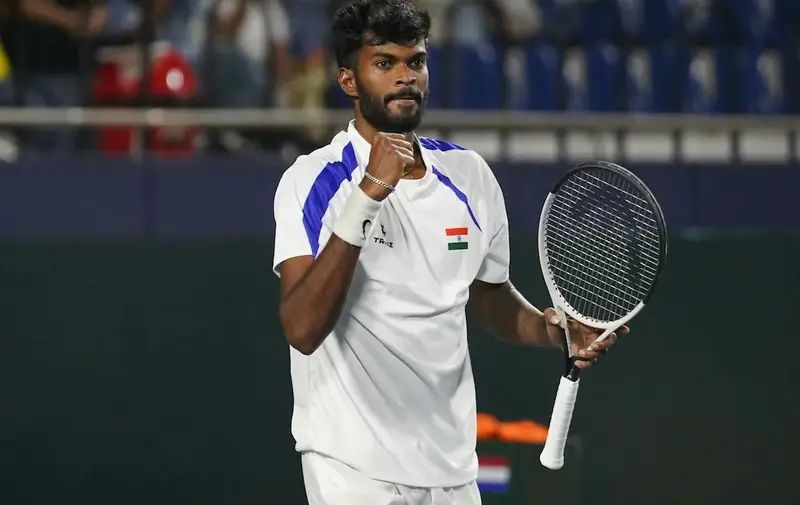
Legends are not always born on the biggest courts or with the highest rankings beside their names. Sometimes, they emerge when a nation is on the brink, when expectation weighs heavy, and when failure would be easier than belief. In the 2026 Davis Cup Round 1 tie against the Netherlands, Indian tennis found such a moment, and Dhakshineswar Suresh Ekambaram answered it. Ranked outside the world’s top 450, playing only his second Davis Cup tie, and standing across the net from higher-ranked, battle-hardened opponents, Suresh did not blink. Instead, he stood tall—literally and metaphorically—and carried India to a historic 3–2 victory that sent shockwaves through the tennis world.The Making of India’s Davis Cup HeroBorn on 29 March 2000, Dhakshineswar Suresh Ekambaram’s journey to this moment has been anything but conventional. Raised in Madurai, Tamil Nadu, Suresh grew into a towering 6-foot-5 athlete, a frame rarely seen in Indian singles tennis. While Indian tennis traditionally thrived on finesse and net play, Suresh evolved with the modern game. Known affectionately as “DK” on the circuit, he built his tennis identity around power, serve dominance, and fearless baseline aggression. His steep-angled first serve, heavy forehand, and calm under pressure set him apart long before the Davis Cup spotlight found him. Before wearing India’s colours on the world stage, Suresh sharpened his game in the United States collegiate system, playing first for Georgia Gwinnett College and later transferring to Wake Forest University. During the 2023–24 season, he formed part of the top-ranked college doubles team alongside Holden Koons, gaining valuable match toughness that would later define his Davis Cup heroics.Beyond the Rankings, Built for the MomentAt the time of the tie, Suresh’s ATP singles ranking stood at world No. 465, a number that did not reflect his true level. Tennis rankings often measure opportunity as much as ability, and Suresh had not yet been given enough big-stage chances. But when the Davis Cup, often called the “World Cup of Tennis,” arrived, rankings became irrelevant. Representing India in the premier international team competition organised by the International Tennis Federation, Suresh played not just for himself, but for history. The Davis Cup, founded in 1900 by Dwight F. Davis, remains one of the most emotionally charged events in world sport. With over 155 nations competing annually, every tie carries national pride, legacy, and pressure that few tournaments can match. Victories here are remembered not as statistics, but as moments.Image Source : Telangana Today Three Matches, One Man, Infinite ImpactIndia’s tie against the Netherlands went down to the wire. And at every crucial turn, Suresh delivered. He won both his singles with authority, showing remarkable composure for a player new to such intensity. When the tie demanded teamwork, he paired with Yuki Bhambri in doubles and produced yet another win, completing a rare three-match sweep for India in a single Davis Cup tie. The decisive moment came when Suresh defeated Guy den Ouden 6–4, 7–6(4), holding his nerve in the tiebreak to seal the historic victory. As the final point was won, it was not just a match that ended; it was a statement that Indian tennis had found a new spearhead.Outlook India Why This Win Means More Than a TieIndia’s 3–2 victory over the Netherlands has taken the team into the Qualifiers second round, where they will face South Korea between 18 and 20 September 2026. Fourteen teams will compete for seven spots in the Davis Cup Finals, to be held in Bologna, Italy, in November 2026. But beyond qualification pathways and tournament structures, this win means something deeper. It marks a shift. For years, Indian tennis has leaned heavily on doubles success. Suresh’s emergence as a reliable singles match-winner under pressure signals the arrival of a new generation—taller, stronger, more aggressive, and mentally hardened for global battles.Image Source : Sportstar - The HinduA New Face of Indian TennisDhakshineswar Suresh Ekambaram is no longer just a promising name on the rankings list. He is proof that Indian tennis is evolving, that belief can outperform numbers, and that heroes can emerge from anywhere. In a sport often dominated by pedigree and privilege, Suresh’s rise feels personal, a reminder that patience and courage still matter. For a nation watching, this was more than a Davis Cup win. It was goosebumps. It was belief. It was the sound of a new era beginning.