
From Grief to Giving: How One Woman Turned an Auto into a Lifeline
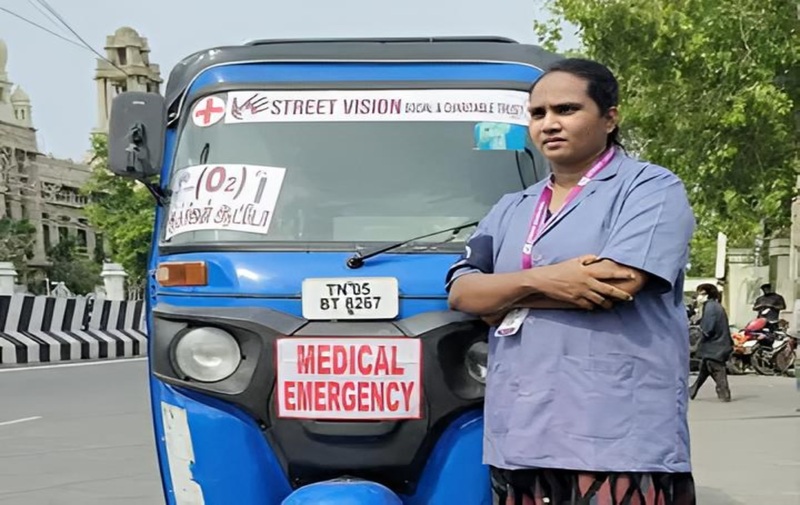
Every morning at exactly 7 am, outside the busy gates of Rajiv Gandhi Government General Hospital in Chennai, an auto-rickshaw arrives and waits. It does not honk impatiently or look for passengers. Instead, it stands still, ready to offer something far more precious than a ride: breath. Painted in blue and black, this auto has become a moving symbol of hope, driven by a woman who refused to let her pain end in silence. R Seetha Devi’s story does not begin with applause or recognition. It begins with a hospital corridor, long hours of waiting, and a daughter watching helplessly as her mother’s life slipped away during the second wave of the pandemic. A Loss That Changed EverythingIn May 2021, Seetha’s 65-year-old mother, a dialysis patient, tested positive for the pandemic. Like thousands of families during that terrifying period, Seetha rushed her mother to the government hospital, hoping timely care would save her. What followed was a nightmare shared by many but carried deeply by few. For more than four hours, they waited outside the hospital as beds were unavailable. Oxygen was scarce. Time passed, hope thinned, and finally, when her mother was admitted, it was already too late. She succumbed to the virus soon after. For Seetha, the grief was crushing, but one thought refused to leave her mind: my mother might have lived if oxygen had reached her earlier. That single thought became the seed of an extraordinary mission.Turning Pain Into PurposeInstead of allowing loss to break her, Seetha chose to respond in the most human way possible by ensuring no one else suffered the same fate. On May 6, 2021, she took an auto-rickshaw that was earlier used by her NGO, Street Vision Social Charitable Trust, to deliver food, and fitted it with an oxygen cylinder. It was a simple idea, born out of urgency rather than planning. But sometimes, the simplest ideas save the most lives. From that day onward, Seetha began driving her oxygen auto every single day to the hospital, staying there for over 12 hours. Patients gasping for breath, waiting outside hospitals, suddenly had a place to sit, rest, and breathe.An Oxygen Auto That Never SleepsSeetha does not operate on fixed duty hours. Her phone remains on 24/7. Whenever a call comes in from a desperate family member, a volunteer, or even a stranger, she responds. With the help of volunteers, patients are guided into the auto, oxygen is administered, and precious minutes are bought. Minutes that often decide between life and death. Since starting this initiative, Seetha has provided free oxygen support to more than 500 people. As demand increased, she converted two more autorickshaws into oxygen-supplying vehicles, expanding the reach of her service across Chennai. She never asks for money. She never asks questions. She only asks one thing: do they need oxygen?Service Beyond SurvivalSeetha’s compassion did not stop at oxygen support. During the pandemic, when fear kept many away, she used her autorickshaw to transport the bodies of unclaimed COVID-19 victims to burial grounds, ensuring dignity even in death. At the same time, she addressed another silent crisis. Recognising the lack of menstrual hygiene facilities in hospitals, she installed sanitary napkin dispensers in 10 hospitals across Chennai. Through her NGO, she also continued delivering food to the needy in her neighbourhood, understanding that hunger, too, is an emergency. Her work reflects a rare understanding that service is not about one problem but about responding wherever humanity calls.A Woman, An Auto, And A Sense of DutySeetha does not describe herself as a hero. She speaks softly, often returning to the same thought that fear and confusion during the second wave left people helpless, and helping them felt like a responsibility rather than a choice. She knows she cannot save everyone. But she also knows that saving even one life gives meaning to her loss. Each patient who breathes easier inside her auto is, in some way, a quiet tribute to her mother. In a city filled with moving vehicles, Seetha’s auto moves something deeper—conscience.Why Her Story Matters TodaySeetha’s journey stands as a reminder that progress does not always come from power or privilege. Sometimes, it comes from movement—physical, emotional, and moral. Her initiative shows how mobility can become a tool for social change, especially when placed in the hands of someone driven by empathy. This is why her story became part of Shell India’s campaign, “Great Things Happen When We Move.” The campaign highlights Indian women who move forward despite setbacks, using mobility as a means to transform not just their lives but the lives of others. Through Seetha’s story, the campaign reinforces a powerful truth: when women are enabled to move, entire communities move with them. Today, as the blue-and-black auto waits outside the hospital each morning, many passers-by may not know the story behind it. But for those who sit inside, breathing in oxygen when they need it most, Seetha is not just a driver. She is proof that from unimaginable loss can come unimaginable kindness.