
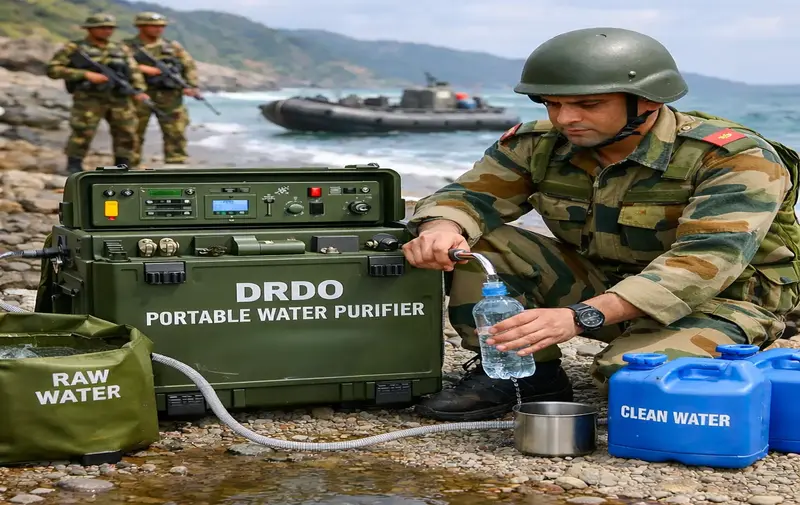
A Lifeline in the Field: DRDO Develops Portable Desalination System for Soldiers
For soldiers deployed in some of the most unforgiving landscapes on Earth, access to safe drinking water can mean the difference between mission success and failure. From salt-laden coastal zones to the icy, high-altitude reaches of Ladakh, potable water is often scarce, unreliable or entirely absent. Addressing this critical operational challenge, the Defence Research and Development Organisation has developed a new hand-operated water purification system that offers troops a dependable lifeline in the field.Introducing SWaDeS: Water Where None ExistsThe newly developed device, named the Sea Water Desalination System, or SWaDeS, has been created by DRDO’s Defence Laboratory in Jodhpur. Designed in response to operational requirements projected by India’s tri-command services, the system reflects a growing emphasis on self-sufficiency and adaptability in modern military operations. SWaDeS is capable of purifying saline water into safe drinking water and can be operated either manually or through an engine-driven mechanism, depending on mission needs and available resources.Built for the Soldier on the MoveOne of the most striking features of SWaDeS is its portability. The manual version of the system is lightweight enough to be carried by a single soldier, a crucial factor for long-range patrols or isolated deployments. In emergency situations, this compact unit can meet the drinking water requirements of a group of 10 to 12 personnel. For troops operating far from supply lines, this means fewer logistical dependencies and greater operational freedom.From Seawater to Safe Drinking WaterThe technical capability of SWaDeS is equally impressive. The engine-operated version of the system is designed to purify seawater with salinity levels as high as 35,000 milligrams per litre of total dissolved solids. Through its filtration and desalination process, it reduces this to below 500 milligrams per litre, which meets permissible drinking water standards. This version can support the daily water needs of 20 to 25 soldiers, making it suitable for larger detachments and semi-permanent installations.Tested Across India’s Most Demanding EnvironmentsAccording to DRDO scientists, SWaDeS has been developed with diverse operational aspects in mind. It is well suited for naval operations and coastal installations, where seawater is abundant but freshwater sources are limited. Beyond the coast, the system is also intended for inland deployment in saline water zones such as Pangong Tso in Ladakh. Located near the Line of Actual Control with China, the high-altitude lake presents unique challenges due to its salinity, extreme cold and strategic importance. The ability to draw drinking water directly from such sources significantly enhances troop sustainability in sensitive border regions.Part of a Broader Water Security MissionSWaDeS is not an isolated innovation. It forms part of a larger portfolio of water purification systems developed by DRDO for both military and civilian use. These include household-level units designed to remove contaminants such as arsenic, iron and manganese, as well as specialised Chemical, Biological, Radiological and Nuclear water purification systems intended for use in contaminated environments. Some of these systems are large, fixed installations, while others are transportable or vehicle-mounted, reflecting a comprehensive approach to water security. DRDO has strengthened the foundation upon which all other operational capabilities depend.Strengthening Security Through SustainabilityAs India continues to modernise its armed forces and expand its humanitarian response capabilities, systems like SWaDeS highlight the importance of sustainable, adaptable solutions. Whether supporting soldiers on a remote patrol, sailors at a coastal outpost, or civilians in a water-stressed region, the Sea Water Desalination System stands as a reminder that sometimes, the most powerful innovations are those that sustain life itself.