"Dream, Dream, Dream! Conduct these dreams into thoughts, and then transform them into action."
- Dr. A. P. J. Abdul Kalam
"Dream, Dream, Dream! Conduct these dreams into thoughts, and then transform them into action."
- Dr. A. P. J. Abdul Kalam
25 Jan 2026
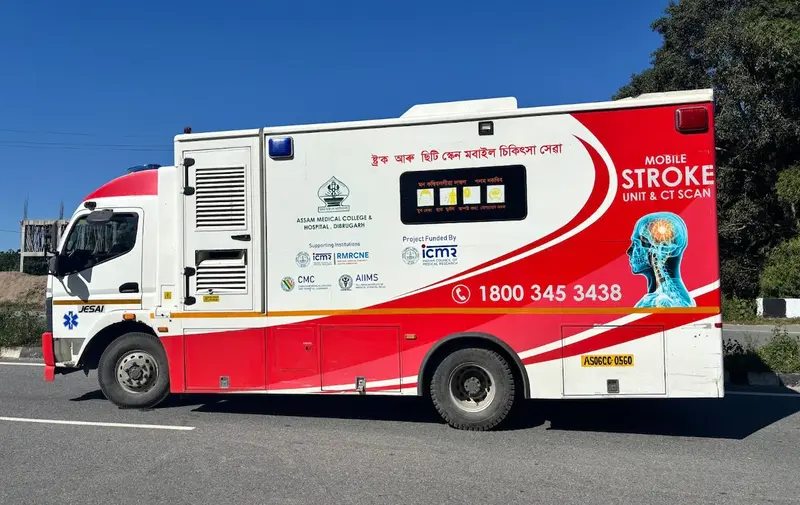
India has taken a decisive step toward transforming emergency healthcare by becoming the second country in the world to successfully integrate Mobile Stroke Units (MSUs) with emergency medical services. Announced by Dr Rajiv Bahl, Secretary, Department of Health Research and Director General of the Indian Council of Medical Research (ICMR), this achievement places India alongside a select group of nations pioneering advanced stroke care beyond hospital walls. More importantly, it signals hope for thousands of patients in rural and remote regions, where every minute lost can mean the difference between life and death.
Stroke is one of India’s leading causes of death and long-term disability. For patients in cities, access to hospitals and specialists is relatively quicker. But in regions like Northeast India, particularly Assam, geography itself becomes an enemy. Long distances, difficult terrain, poor connectivity, and lack of specialised neurological care have historically delayed treatment, often pushing patients far beyond the critical “golden hour” when stroke intervention is most effective. Recognising this gap, ICMR envisioned a model where the healthcare system moves toward the patient instead of the patient struggling to reach care. The result was the Mobile Stroke Unit, a fully equipped hospital on wheels designed specifically for emergency stroke response.
The handover of two Mobile Stroke Units to the Assam government marks the culmination of an extensive pilot phase under the ICMR-led study titled Stroke Care Pathways. Instead of ending the project after research, ICMR chose continuity over closure, donating the units to ensure that people in Assam continue to benefit from rapid stroke care. Dr Rajiv Bahl highlighted that while MSUs were first developed in Germany and tested in major global cities, India stands apart for successfully evaluating and integrating them in rural, remote, and difficult terrain.
A Mobile Stroke Unit is not just an ambulance. It is a compact, high-tech emergency department designed for one of the most time-sensitive medical conditions. Each MSU is equipped with a CT scanner for immediate brain imaging, point-of-care laboratory facilities, teleconsultation systems connecting patients to neurologists, and clot-busting drugs essential for treating acute ischemic strokes. This setup allows doctors to diagnose the type of stroke on the spot, rule out bleeding, and begin treatment while the patient is still at home or en route to a hospital. In stroke care, this early intervention can prevent irreversible brain damage and dramatically improve outcomes.
The results from Assam have been nothing short of transformative. According to official data, the MSU model reduced treatment time from nearly 24 hours to about two hours. Stroke-related deaths dropped by one-third, while long-term disability was reduced by eight times. Behind these numbers are stories of elderly farmers who can walk again, breadwinners who return to work, and families spared the emotional and financial devastation that stroke often brings. For many in rural Assam, this initiative has turned a medical emergency from a life sentence into a survivable event.
To support this model, ICMR also established a neurologist-led stroke unit at Assam Medical College and Hospital in Dibrugarh, along with physician-led stroke units at Tezpur Medical College Hospital and Baptist Christian Hospital in Tezpur. This network ensures continuity of care—from on-the-spot diagnosis in the MSU to specialised treatment in hospitals. P. Ashok Babu, Secretary and Commissioner of Health, Assam, noted that the integration of MSUs has strengthened the state’s emergency response system, enabling faster coordination, better outcomes, and a strong foundation for future expansion. Globally, very few countries have managed to deploy Mobile Stroke Units effectively, and even fewer have adapted them for rural populations. By doing so, India has demonstrated that world-class medical innovation is not limited to urban centres or wealthy nations. It can be inclusive, scalable, and deeply rooted in public health needs.
The success of Mobile Stroke Units in Assam opens the door for expansion across other underserved regions of India. As stroke cases continue to rise due to aging populations and lifestyle changes, such innovations will become increasingly critical. By ensuring that treatment travels to patients, India has reimagined emergency care for the 21st century. The MSU program is not just a medical milestone; it is a promise of equitable healthcare, delivered where it is needed most, and delivered in time. In doing so, India has not only saved lives but also set a global example of how compassion, science, and public policy can come together to change the course of healthcare history.
Romanticizing life and shaping stories from everything I see through my journalistic lens. Also, I love sports on the side.