"Dream, Dream, Dream! Conduct these dreams into thoughts, and then transform them into action."
- Dr. A. P. J. Abdul Kalam
"Dream, Dream, Dream! Conduct these dreams into thoughts, and then transform them into action."
- Dr. A. P. J. Abdul Kalam
19 Jan 2026
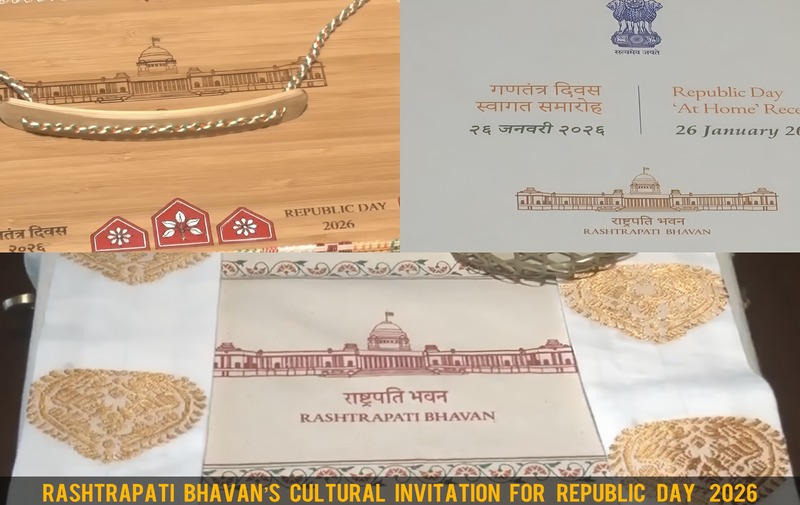
As India prepares to celebrate its 77th Republic Day, the grandeur of Rashtrapati Bhavan is matched by a quieter, deeper kind of pride one rooted not in spectacle, but in craftsmanship. For the Republic Day 2026 ‘At Home’ reception, Rashtrapati Bhavan has unveiled a truly distinctive invitation card, designed by the National Institute of Design (NID), Ahmedabad. More than an invite, it is a cultural statement that places India’s North-Eastern region at the very heart of the nation’s ceremonial narrative. At a time when Republic Day often evokes images of military parades and national power, this invitation gently redirects attention to something equally powerful: living traditions, sustained by hands that have worked silently for generations.
The invitation has been specially curated to honour the Ashtalakshmi states of North-East India Arunachal Pradesh, Assam, Manipur, Meghalaya, Mizoram, Nagaland, Tripura, and Sikkim. Designed by NID Ahmedabad, the card reflects a sensitive understanding of design as a bridge between culture and contemporary India. Every element has meaning. Every texture carries a story. The invitation does not merely represent the North-East; it collaborates with it, allowing traditional artisanship to speak in its own voice.
The invitation’s bamboo cover and box are central to its soul. Bamboo is not just a material in the North-East; it is livelihood, architecture, music, and ritual. Its fast growth, strength, and sustainability make it both an ecological asset and a cultural symbol. The invitation box is crafted from a woven bamboo mat made on a loom using dyed cotton threads on the warp and fine bamboo splits on the weft, a technique traditionally practiced in Tripura. This form of weaving has sustained communities for centuries, providing economic stability while preserving cultural identity. A handmade paper tag on the outer cover carries the guest’s address, accompanied by a bamboo artwork created from a specially smoked bamboo split. The smoking process gives the bamboo its deep brown hue, reflecting knowledge passed down through generations—knowledge rarely documented but carefully remembered.
Opening the invitation reveals a wall-hanging scroll constructed with an octagonal bamboo weave pattern. As the scroll unfolds, it presents a thoughtfully curated display of handcrafted creations from each North-Eastern state. This act of unfolding is symbolic. Much like the North-East itself often misunderstood or overlooked, the invitation reveals its beauty gradually, inviting patience, curiosity, and respect. The motifs on the cover and box draw inspiration from Assamese manuscript painting traditions, once used to illustrate sacred texts. Beneath the invitation, fabric panels depict the flora and fauna of the region, reminding the viewer that culture here grows in close harmony with nature.
Among the most touching inclusions is the Eri silk stole, designed exclusively for this occasion. Known as “Peace Silk” or “Ahimsa Silk,” Eri silk is produced without killing the silkworm, aligning craft with compassion. Eri silk is deeply embedded in the economy and identity of North-East India. By including it in the invitation, Rashtrapati Bhavan elevates not only the fabric, but also the philosophy it represents: sustainability, non-violence, and coexistence. For the guest, draping the stole becomes an intimate connection with the land and people who made it.
The invitation also features Longpi Black Pottery from Manipur, an ancient craft practiced by the Tangkhul Naga tribe since the Neolithic period. Made without a potter’s wheel, this pottery reflects a primal relationship between earth and fire, utility and beauty. From Mizoram comes the handwoven Puan Chei, a traditional shawl or wraparound skirt worn during important ceremonies. Its presence brings the warmth of community gatherings and shared celebrations into the formal space of Rashtrapati Bhavan. Nagaland contributes one of the most evocative pieces: fabric woven from wild orange rhea and Himalayan stinging nettle, known locally as Ehlon Niu. Created by the Khiamniungan Naga tribe, this rare textile tells a story of revival of traditions once nearly lost, now carefully restored through collective memory and effort.
Tucked within the invitation is the Gogona, a bamboo jaw harp from Assam. Played during Rongali Bihu, the Assamese New Year, the Gogona’s gentle twang welcomes spring, renewal, and joy. Its inclusion transforms the invitation into something interactive. This is not an object meant only to be seen but to be touched, played, and felt—much like culture itself. For the guests, many of whom will come from across India and the world, the invitation becomes a personal journey into a region often known only through headlines and maps. It invites empathy, curiosity, and respect—qualities essential to a living republic.
As preparations for the 77th Republic Day continue in full swing, Rashtrapati Bhavan’s ‘At Home’ invitation quietly redefines celebration. It proves that national pride can be expressed not only through grandeur but also through gratitude—gratitude to the communities that keep India’s cultural soul alive. In bamboo and silk, in music and motif, this invitation reminds us that the Republic is not just written in the Constitution but woven daily by its people.
Romanticizing life and shaping stories from everything I see through my journalistic lens. Also, I love sports on the side.