"Dream, Dream, Dream! Conduct these dreams into thoughts, and then transform them into action."
- Dr. A. P. J. Abdul Kalam
"Dream, Dream, Dream! Conduct these dreams into thoughts, and then transform them into action."
- Dr. A. P. J. Abdul Kalam
23 Jan 2026
For years, global trade moved on predictable tracks. Then tariffs became weapons, supply chains became battlegrounds, and trust between long-time partners began to crack. When the United States turned inward with aggressive tariff policies, the shockwaves travelled far beyond Washington. Canada’s electric vehicle agreement with China was one sign of this shift. Europe’s next move towards India may be the most consequential yet. European Commission President Ursula von der Leyen’s announcement of a mega India–EU deal, now being called the “mother of all deals,” reflects a world urgently redrawing its economic map.
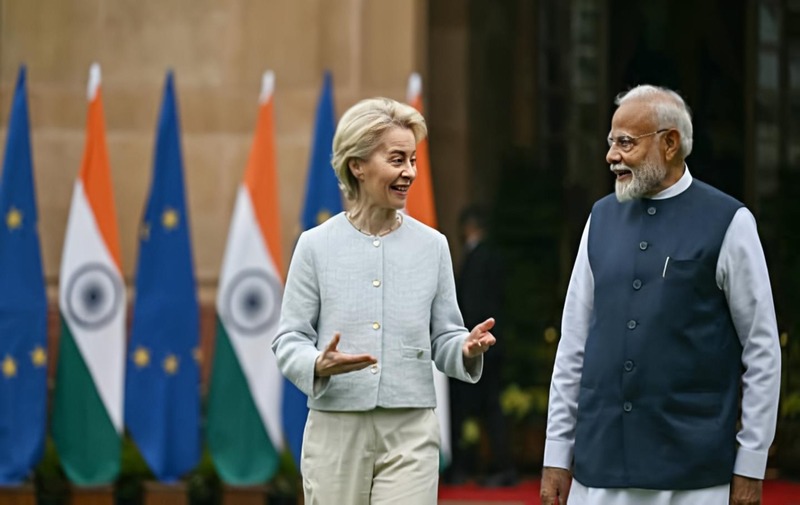
The timing of this announcement is no coincidence. European Council President Antonio Luís Santos da Costa and Ursula von der Leyen are scheduled to visit India from January 25 to 27 as chief guests at India’s 77th Republic Day celebrations. Alongside the symbolism of the visit, they will co-chair the 16th India–EU Summit on January 27. Diplomatic gestures rarely come without intent. This visit signals Europe’s clear message: India is no longer just an emerging market but a central pillar in the future global order.
Taken together, India and the European Union represent an economic force few partnerships can match. The EU’s 27 member states—ranging from Germany and France to Sweden and Poland—together house about 45 crore people. When combined with India’s population, the partnership represents 191.3 crore people, nearly 23 percent of the global population. This is not just a market; it is a world within the world.
In economic terms, the numbers are equally striking. In 2024, India and the EU together recorded a nominal GDP of $23.41 trillion, accounting for 21 percent of global GDP, according to World Bank data. In global trade, their combined share stands at 33 percent of exports and 32 percent of imports. Few alliances can claim this kind of reach or influence.
The European Union is currently India’s second-largest trading partner. In 2024 alone, trade in goods between the two reached €120 billion, accounting for 11.5 percent of India’s total trade. India’s exports to the EU include machinery, chemicals, base metals, mineral products, and textiles sectors that employ millions of Indian workers. Imports from the EU largely consist of machinery, transport equipment, and advanced chemicals, which support India’s manufacturing and infrastructure ambitions. What stands out is the direction of growth. India’s exports to the EU have risen sharply over the past year, reaching €71.3 billion, while imports grew marginally to €48.8 billion. This trend reflects India’s growing competitiveness and Europe’s increasing reliance on diversified supply chains outside traditional partners.
Trade figures tell only part of the story. Nearly 6,000 European companies currently operate in India, contributing not just capital but also technology, skills, and global business standards. The EU’s foreign direct investment stock in India has grown dramatically from €82.3 billion in 2019 to €140.1 billion in 2023, making it one of India’s largest foreign investors. This investment shows up in everyday life in quiet ways. European-funded factories create jobs in Indian cities. Green technology collaborations influence cleaner energy projects. Research partnerships connect universities and innovation hubs. On the other side, Indian companies are also expanding into Europe, with India’s FDI stock in the EU standing at €10.2 billion—a figure expected to rise as barriers fall.
The India–EU partnership is unfolding at a time when globalisation is being questioned, not celebrated. Protectionism is rising, and geopolitical tensions are reshaping trade routes. In this environment, the “mother of all deals” sends a powerful signal: cooperation between democracies across continents is still possible and profitable. For Europe, India offers scale, growth, and a reliable alternative to overdependence on any single market. For India, the EU provides access to advanced technology, capital, and one of the world’s richest consumer bases. For the rest of the world, this deal could stabilise global trade flows at a moment when uncertainty has become the norm.
As Donald Trump’s tariff-heavy approach begins to show its limits, the India–EU deal represents a quieter, steadier response, one based on partnership rather than pressure. It is not about choosing sides but about choosing stability. If successful, this agreement could become a blueprint for future global cooperation, proving that in a divided world, bridges still matter. The “mother of all deals” is not just about India and Europe. It is about the direction the world chooses next.

Writing about what truly matters, good news and stories to remind the world - it is brighter than we think.