"Dream, Dream, Dream! Conduct these dreams into thoughts, and then transform them into action."
- Dr. A. P. J. Abdul Kalam
"Dream, Dream, Dream! Conduct these dreams into thoughts, and then transform them into action."
- Dr. A. P. J. Abdul Kalam
13 Dec 2025
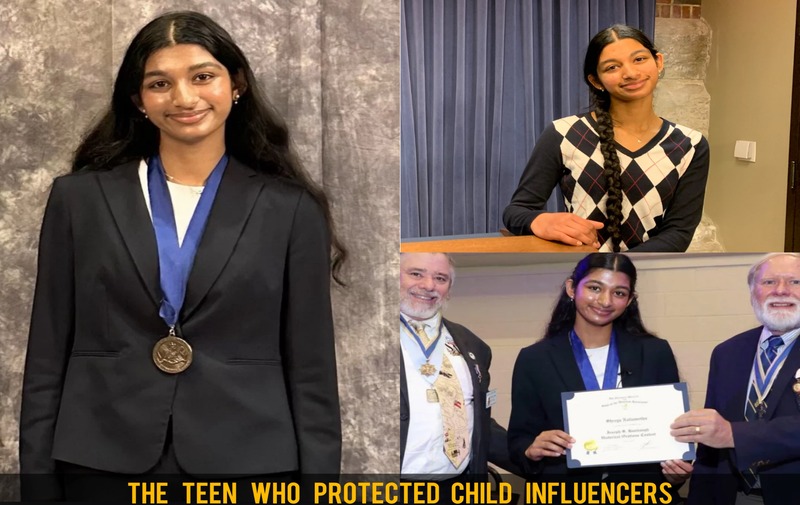
In the early months of the 2020 pandemic, when the world was locked indoors and teenagers were glued to screens for comfort, entertainment, and connection, 13-year-old Shreya Nallamothu from Illinois stumbled upon a question that would change U.S. law. As she scrolled through Instagram, YouTube, like millions of kids her age, something began to bother her. She watched child influencers, some barely able to speak, performing skits, unboxing toys, sharing their lives online, and earning massive views. The content looked innocent and fun, but beneath the surface, Shreya sensed something troubling.
These children were working. They were generating income. And yet, they had no legal protections. That moment of curiosity grew into a realization: while the digital world had evolved at lightning speed, the law had not kept up. Child actors in Hollywood were protected by the Coogan Law of 1939, which required parents to save a portion of their children’s earnings. But no such law existed for child influencers despite the fact that many of them were earning money through sponsorships, brand deals, and ad revenue. The deeper Shreya dug, the more she uncovered a hidden crisis.
Shreya learned that social media platforms did not allow minors to legally run their own accounts. Instead, all earnings went directly to the parents who managed these channels. There were no guidelines, no mandatory savings, and no accountability. Parents could use every dollar earned by their children without leaving them a single cent. For Shreya, the injustice felt personal. The idea that thousands of children were unknowingly contributing to family incomes without being assured their own financial security was troubling. Many of these kids were too young to understand the consequences, too trusting to question adults, and too visible in a digital world that never forgets. It was a blind spot so obvious in hindsight that adult lawmakers and digital regulators had simply overlooked it. But a 13-year-old saw what millions did not.
Instead of accepting the problem as too big for someone her age, Shreya decided to act. She sat down and wrote a detailed, thoughtful letter to Illinois State Senator Dave Koehler. In it, she explained how child influencers were generating substantial income yet had no legal right to their own earnings. She pointed out the contrast between traditional entertainment laws and the ungoverned digital creator world. She argued that the law needed to evolve. Her letter struck a chord. Senator Koehler, impressed by her clarity and courage, invited her to collaborate with his team. Together, they drafted a groundbreaking bill, the Child Social Media Influencer Protection Act. This proposed law would require parents to deposit at least 15% of a child influencer’s earnings into a blocked trust account, money that the child alone could access upon reaching adulthood. It also ensured that children had rights over the content featuring them.
Passing the bill was not easy. Many lawmakers initially dismissed the issue, believing that influencer income was too small or that family matters should remain private. Some viewed it as a niche problem. Others thought regulation was unnecessary. But Shreya persisted, armed with research, comparisons to existing child labor laws, and real-life examples of exploitation. Her determination paid off. Lawmakers from both major parties began to recognize the urgency. They realized that in an age where children could amass millions of followers and earn substantial revenue, the law needed to offer protection. In 2023, Illinois became the first state in the United States to pass a law safeguarding the earnings of child influencers. It was a historic victory, one that echoed far beyond Illinois.
Shreya’s success proved that youth activism is not symbolic; it can reshape systems. Two years later, in 2025, California passed its own influencer protection law, inspired partly by Illinois. Other states began discussions. Experts and lawmakers across the country referenced Shreya’s advocacy as a turning point. Federal conversations began forming around the need for nationwide protections for young digital creators. For Shreya, who is now a Robertson Scholar at Duke University, the achievement marked not just a victory for child influencers, but a victory for youth leadership. Her work demonstrated that young people understand the digital world more deeply than many adults—and that they have both the clarity and courage to challenge outdated systems.
Shreya’s story is part of a powerful movement led by young Indians in the diaspora who are using their voices to create meaningful change. From climate activist Kevin Patel pushing for environmental justice in California to teenage scientist Gitanjali Rao tackling water contamination and cyberbullying, young Indian-origin leaders are shaping public policy, science, and civic action. They carry forward values of education, responsibility, and justice instilled by immigrant families, proving that age is not a barrier to impact. Shreya stands among them, an unexpected activist who turned a simple question into a historic reform.

Writing about what truly matters, good news and stories to remind the world - it is brighter than we think.