"Dream, Dream, Dream! Conduct these dreams into thoughts, and then transform them into action."
- Dr. A. P. J. Abdul Kalam
"Dream, Dream, Dream! Conduct these dreams into thoughts, and then transform them into action."
- Dr. A. P. J. Abdul Kalam
4 May 2026
In the quiet village of Nirona, in Kutch, where dusty roads meet centuries-old traditions, an extraordinary art form continues to breathe through the hands of a few dedicated artisans. Among them stands Sumar D. Khatri, a master craftsman whose life is deeply intertwined with the survival of Rogan art, a rare, 400-year-old textile painting tradition. Recognised with the National Award in 2003 and State Award in 2000, Sumar Khatri is not just an artist; he is a guardian of heritage, carrying forward a legacy that once stood on the brink of extinction.
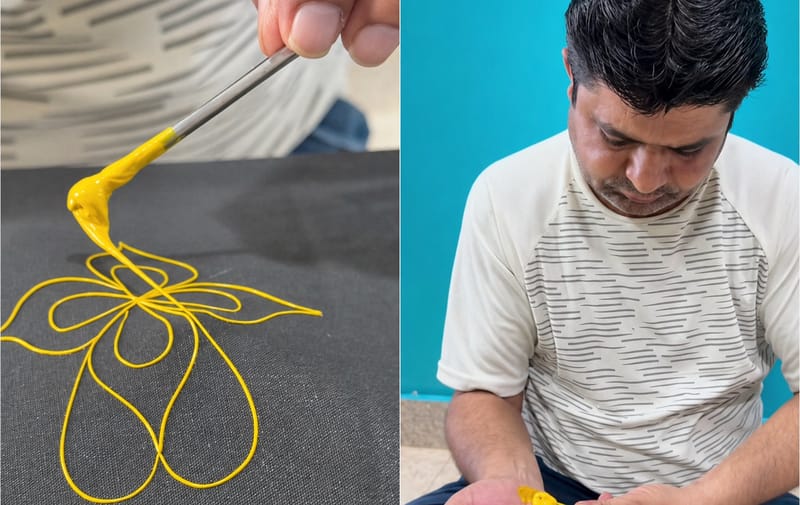
Rogan Art traces its origins back to ancient Persia before finding a home in the Kutch region of Gujarat. Practiced primarily by the Khatri community, this intricate art involves painting on fabric using a thick paste made from castor oil and natural pigments. The process itself is almost meditative. Artisans boil castor oil for nearly two days to create a dense substance known as “rogan.” Using a thin metal stylus, they draw elaborate patterns freehand, without even touching the fabric directly. One of the most iconic designs to emerge from this tradition is the “Tree of Life,” a symbol of growth, connection, and continuity. For generations, this art adorned everyday textiles, skirts, odhanis, and household fabrics used by local communities.
However, the journey of Rogan Art has not been smooth. With the rise of machine-made textiles in the 1950s, handmade crafts across India began to lose their market. Rogan Art was no exception. By the late 1980s, the craft was on the verge of disappearing. The families who had preserved it for generations, including the Khatris, found themselves struggling to survive. Poverty became a harsh reality. For Sumar Khatri and his elder brother Abdulgafur Khatri, childhood was marked by hardship. There were days when survival mattered more than art. Abdulgafur sold vegetables, while Sumar worked at a tea shop for just two rupees a day. Education became a luxury they could not afford, forcing both brothers to drop out of school. Yet, even in those difficult times, the connection to their ancestral craft remained quietly alive.
At one stage, continuing Rogan Art seemed impossible. Abdulgafur Khatri left for Mumbai in search of work, determined to escape the cycle of poverty. But destiny had other plans. A letter from his grandfather in 1984 called him back to Nirona, urging him to continue the family tradition. Around the same time, the Gujarat government initiated efforts to revive Rogan Art in 1985. This moment became a turning point. Abdulgafur returned not just to practice the art but to reinvent it. Standing beside him was Sumar Khatri, equally committed to rebuilding what was nearly lost.
Earlier, Rogan work was primarily functional, created for local use. But the Khatri brothers saw a larger vision. They transformed Rogan into a refined art form, introducing intricate designs that could appeal to global audiences. Sumar Khatri played a crucial role in this transformation. His dedication to precision, innovation, and quality helped elevate the craft beyond its traditional boundaries. Together, the brothers popularised the “Tree of Life” motif, which would go on to become a global symbol of Rogan Art. Their work began reaching international platforms, attracting collectors, designers, and cultural institutions. A defining moment came in 2014, when a Rogan painting created by Abdulgafur Khatri was gifted by Narendra Modi to Barack Obama, bringing worldwide attention to this rare art form.
While global recognition often highlights major milestones, the real story lies in the everyday dedication of artists like Sumar Khatri. His journey is not one of sudden success but of consistent effort, resilience, and belief. As a master craftsman, Sumar has continued to practice and promote Rogan Art, ensuring that the techniques, patterns, and knowledge are passed on to future generations. His awards, the State Award in 2000, the National Award in 2003, and the Pride of Kutch in 2008 are reflections of years of silent perseverance. He represents the spirit of artisans who work behind the scenes, preserving culture not for fame, but for identity.
Today, Rogan Art remains one of the rarest art forms in the world, practiced by only a handful of families in Nirona. Despite modern challenges, Sumar Khatri continues to create, teach, and inspire. The art has also evolved in its applications. While it was once used mainly for clothing, it is now seen on wall hangings, cushion covers, and decorative pieces, making it relevant in contemporary spaces. This evolution has helped sustain the craft economically while retaining its traditional essence. Through every stroke of Rogan, Sumar is not just painting patterns; he is preserving history, culture, and a way of life. And in doing so, he ensures that the legacy of Nirona continues to live on, one intricate design at a time.
Romanticizing life and shaping stories from everything I see through my journalistic lens. Also, I love sports on the side.