"Dream, Dream, Dream! Conduct these dreams into thoughts, and then transform them into action."
- Dr. A. P. J. Abdul Kalam
"Dream, Dream, Dream! Conduct these dreams into thoughts, and then transform them into action."
- Dr. A. P. J. Abdul Kalam
12 Feb 2026
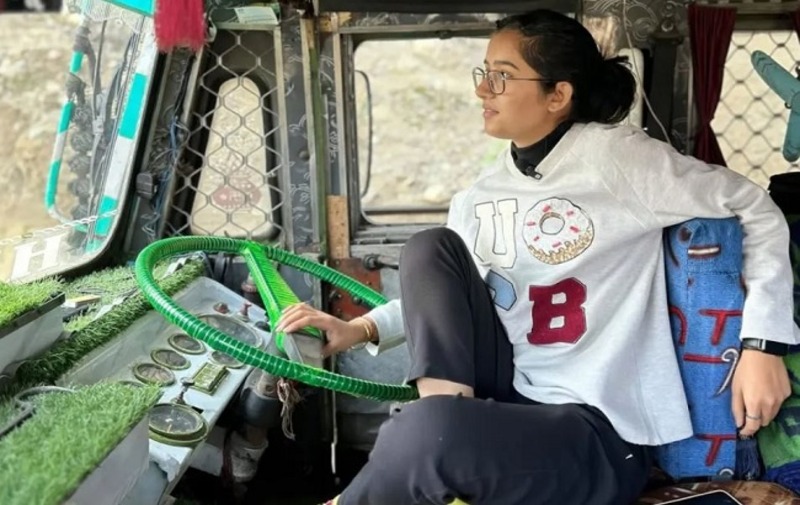
Can you imagine driving your car on a highway and suddenly noticing that the driver of a roaring 16-tonne truck beside you is a young woman? For a moment, you might be surprised, even shocked, questioning what you just saw. In a country where truck driving is still seen as a man’s world, such a sight disrupts long-held assumptions. And if you ever do come across a woman confidently steering a heavy truck through Himachal Pradesh’s steep curves and misty roads, chances are it is Neha Thakur. At just 23, Neha has become a powerful symbol of grit, aspiration, and quiet rebellion against gender stereotypes that have ruled India’s logistics sector for decades.
Neha Thakur hails from Khudla village in Sarkaghat, Mandi district, a place surrounded by hills and highways that shaped her childhood. Her dream did not emerge from ambition alone but from countless journeys with her father, a truck driver himself. Sitting beside him, watching the roads unfold through Himachal’s mountains, Neha fell in love with driving long before she understood how unconventional that love would be.
After completing her graduation, Neha’s life seemed to follow a different path. She trained as an air hostess and later took up a private job in Chandigarh. But in 2021, the pandemic abruptly ended that chapter, leaving her unemployed and uncertain. What followed was not despair, but a return to home, to family, and ultimately, to her childhood dream. When she took the steering wheel of her father’s truck for the first time, it was not just a career decision. It was a moment of self-belief.
Despite her passion, the road was never easy. Truck driving remains one of the most male-dominated professions in India, especially for heavy vehicles. Neha enrolled in a driving school at the age of 21, ignoring skepticism, whispers, and outright criticism. In 2023, she earned her heavy motor vehicle licence, officially stepping into a space few women have dared to enter. That year marked a milestone Neha became Himachal Pradesh’s first woman truck driver and the state’s first woman truck vlogger.
Her achievement was both deeply personal and broadly symbolic. It signalled that women could belong not just in cabins and offices but also behind massive steering wheels on unforgiving roads. Today, Neha drives a 16-tonne Tata truck, transporting construction material and farm produce across local and interstate routes, sometimes covering up to 500 kilometres a day. Each journey demands physical endurance, technical skill, and mental resilience—qualities she demonstrates daily.
Yet, Neha is candid about the challenges women face on the road. The lack of basic washroom facilities, safety concerns, and social scrutiny remain constant obstacles. She currently limits herself to local routes, acknowledging that the ecosystem is still not fully supportive of women on long-haul journeys. But instead of letting these barriers stop her, Neha adapts. She manages logistics, schedules, and challenges with quiet determination, proving that competence, not gender, defines capability. Her message to young women is clear and empowering: do not abandon your dreams because they seem unconventional. If you want to drive a truck, learn it, own it, and make space for yourself.
Neha’s influence extends far beyond highways. With over 4 lakh followers on YouTube and 7 lakh on Instagram, her vlogs document life on the road raw, real, and inspiring. She shares not just driving experiences but also the emotional realities of choosing an unconventional path. This visibility has translated into measurable change. The Mandi Regional Transport Office reported a 15% increase in women applying for heavy vehicle licences, crediting Neha’s influence and online advocacy. Officials have publicly acknowledged her role in motivating women to explore careers in transport. Local traders, too, rely on her services, praising her punctuality, safety record, and professionalism proof that trust is built on performance, not prejudice. Neha’s story aligns with broader shifts across Himachal Pradesh and India. In 2024, the state organised women-only driver training camps, licensing 150 women to address a driver shortage. Nationally, the number of women heavy vehicle drivers rose from 400 in 2022 to 1,200 in 2025. Yet women still make up less than 2% of India’s truck drivers, underlining how exceptional and necessary stories like Neha’s remain.
Neha Thakur is not just transporting goods; she is transporting ideas of equality, courage, and coexistence. Her journey reminds us that progress does not always arrive loudly. Sometimes, it comes wrapped in the hum of an engine, moving steadily through winding roads. By challenging stereotypes with empathy and action, Neha steers us toward a kinder world, one where shared dreams outweigh rigid norms and where every mile driven makes space for someone else to follow. True progress blooms when resilience meets support. And on Himachal’s highways, that progress is already on the move with one courageous woman at the wheel.
Romanticizing life and shaping stories from everything I see through my journalistic lens. Also, I love sports on the side.