"Dream, Dream, Dream! Conduct these dreams into thoughts, and then transform them into action."
- Dr. A. P. J. Abdul Kalam
"Dream, Dream, Dream! Conduct these dreams into thoughts, and then transform them into action."
- Dr. A. P. J. Abdul Kalam
14 Dec 2025
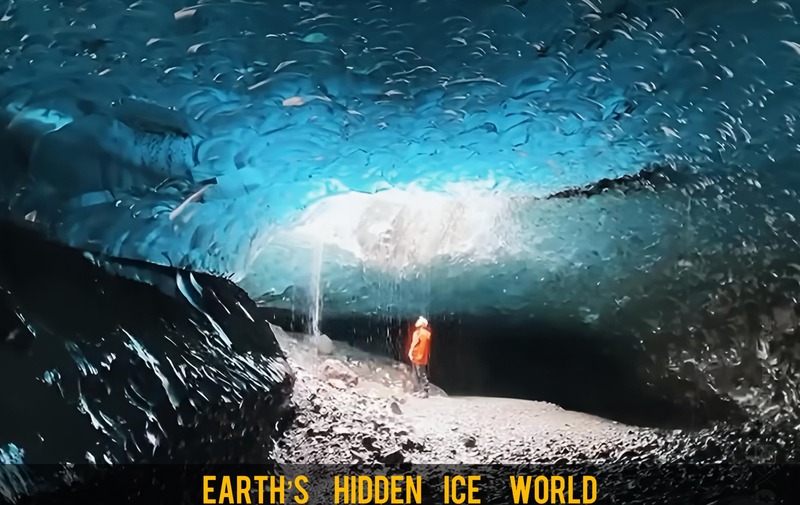
Nature has a way of surprising us when we least expect it. Off the Antarctic Peninsula, near the George VI Ice Shelf in the Bellingshausen Sea, scientists recently witnessed something that felt almost unreal. As temperatures dipped to extreme lows and pressure on the ice increased, a giant iceberg broke away from the shelf. For a brief window of time, the frozen ocean, usually a symbol of stillness, silence, and mystery, revealed a hidden world beneath its thick, icy skin. What emerged was one of the rarest natural sights on Earth. Clear blue layers of ancient ice, shimmering light patterns, and untouched marine textures came into view. It was as though nature had opened the door to a time capsule that had remained sealed for centuries. Researchers who were present described the moment as stepping into another dimension, one carved by time, temperature, and silence.
The first thing that stunned the researchers was the clarity. Under the fractured sheets of ice, the water appeared impossibly pure, glowing like liquid glass. Sunlight, refracted through thick layers of ice, created patterns so delicate they looked like artwork. Soft blues, gentle greens, and crystalline textures formed by decades of freezing, thawing, and compacting. Some sections revealed ancient trapped air bubbles, preserved in the ice since long before humans built cities or invented machines. Each bubble held a tiny piece of Earth’s past atmosphere, offering clues to historical climate patterns. Other parts displayed ice-carved formations shaped by slow-moving ocean currents, frozen in time like sculptures. Marine biologists also noted patches of seafloor that sunlight had not touched for hundreds of years. Without the heavy ice lid, these areas shimmered faintly, exposing sediments, mineral textures, and signs of unseen ecosystems. It was a moment of pure scientific wonder .
The George VI Ice Shelf is known for its massive, ancient ice structures. But what made this moment so extraordinary is that the underside of such ice is almost never visible. These underwater landscapes are typically sealed away, undisturbed, and hidden from human eyes When the iceberg calved, it lifted the icy barrier like a curtain. Beneath it lay a frozen memory of the planet layers that had been forming long before modern human life. Researchers believe that some marine organisms living in these regions may have evolved in complete darkness, untouched by sunlight or external predators. Discovering such ecosystems can reshape our understanding of how life adapts under extreme conditions. This rare opening also offered scientists a chance to study how climate change is affecting ice shelves. The patterns in the exposed ice, the thickness of layers, and the trapped air all serve as natural records reminding us of how different the world used to be and how quickly it is changing today.
If you stand beside a frozen ocean, what you usually see is vast white plains, silent winds, and endless layers of ice. But beneath that stillness lies life, history, and mystery. This event reminds us of two important truths. The first is that Earth is full of wonders we still haven’t discovered. Even today, with satellites, deep-sea vehicles, and huge research missions, there are places we have never seen until nature decides to reveal them. The second is that these wonders are fragile. Ice shelves are thinning, temperatures are rising, and ancient landscapes that survived for centuries are now at risk of vanishing. The beauty that researchers witnessed was breathtaking, but it was also a warning. Moments like this urge us to protect the delicate balance of our planet. They remind us that every iceberg, every glacier, and every stretch of frozen ocean holds stories—stories that may disappear forever if we fail to act.
Even though this event took place thousands of kilometers away in the coldest part of Earth, it speaks directly to all of us. The hidden world beneath the frozen ocean is not just a scientific discovery; it is a reflection of how much remains unseen in nature and within ourselves. Just like the ice hides entire ecosystems, our world often hides truths, memories, and lessons beneath the surface. Sometimes it takes a crack, a shift, a change, or a moment for something precious to finally reveal itself. The Antarctic moment reminds us to look deeper, to appreciate what lies beneath the obvious, and to understand that our planet is alive with mysteries waiting to be uncovered. And, most importantly, that it is our responsibility to protect these wonders before they slip away.

Romanticizing life and shaping stories from everything I see through my journalistic lens. Also, I love sports on the side.