"Dream, Dream, Dream! Conduct these dreams into thoughts, and then transform them into action."
- Dr. A. P. J. Abdul Kalam
"Dream, Dream, Dream! Conduct these dreams into thoughts, and then transform them into action."
- Dr. A. P. J. Abdul Kalam
24 Apr 2026
In the rugged landscapes of New South Wales, the 2019–20 bushfire season left behind more than charred forests and blackened hills. It created a silent crisis, one that unfolded after the flames had disappeared. Among the survivors were the vulnerable brush-tailed rock-wallaby, small, agile creatures that had managed to escape the inferno by retreating into rocky outcrops. Their survival, at first glance, felt like a rare piece of good news in a season of devastation. But survival, as it turned out, was only the beginning of another struggle.
Bushfires do not just burn trees; they erase entire ecosystems in a matter of hours. For wildlife, the immediate danger is fire. The long-term danger is something quieter but just as deadly: the loss of food and shelter. For the brush-tailed rock-wallabies, the fires stripped their habitats of vegetation. The grasses, shrubs, and plants they relied on for food were gone, leaving behind bare, scorched slopes. In such conditions, the landscape no longer behaves like a home. It becomes a place of exposure, where animals must search farther for food, risking predators and exhaustion. Hunger sets in slowly, often unnoticed until it becomes fatal. This was the second crisis, one that followed the flames but was no less threatening.
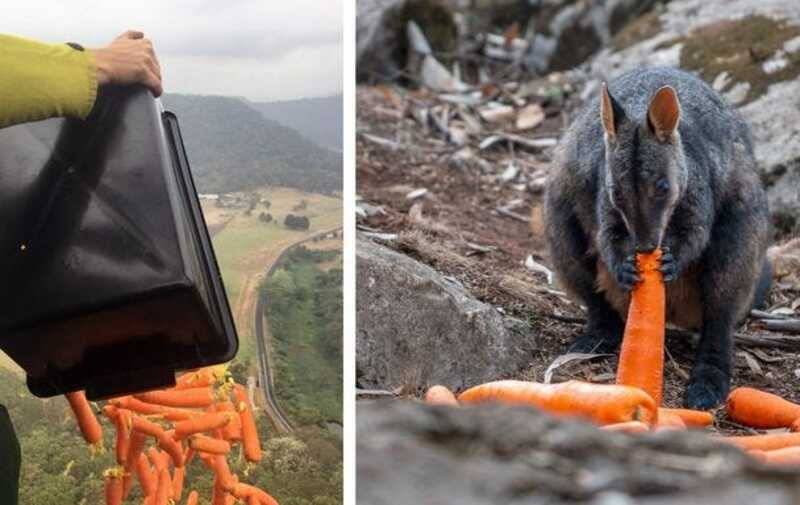
In response to this unfolding crisis, conservationists and authorities in New South Wales made a decision that seemed almost surreal. Helicopters took to the skies not to fight fires, but to deliver food. Carrots and sweet potatoes were dropped into the rocky habitats where wallaby colonies lived. The idea was simple yet profound: provide enough sustenance to help these animals survive until the natural vegetation could regenerate. At first glance, the image feels almost like a storybook: bright orange carrots falling onto dark, burned earth. But behind it lies a deeply practical understanding of ecology. In a damaged environment, intervention becomes necessary. Without it, many species would not survive the gap between destruction and recovery.
The concept of aerial food drops is not entirely new, but it becomes especially critical in extreme situations like bushfires. After a fire, ecosystems do not recover instantly. It can take months or even years for vegetation to regrow. During this time, animals face a severe shortage of food, making survival uncertain. For species like the brush-tailed rock wallaby, which already face threats from habitat loss and predators, such disruptions can be catastrophic.
Food drops act as a temporary lifeline. They do not replace the natural ecosystem, but they bridge the gap—buying time for both the animals and the land to heal. Conservationists aim to provide just enough support without disrupting natural behaviors. Overdependence on human-supplied food can create new challenges, altering feeding patterns and ecological balance. In this case, the goal was clear: short-term assistance, not long-term dependency. By targeting specific habitats and monitoring the wallaby populations, authorities ensured that the intervention remained focused and effective.
The image of carrots falling from the sky may seem unusual, even surreal. But in a world increasingly affected by climate change and extreme weather, such actions may become more common. They represent a shift in how we respond to environmental crises, not just reacting to immediate threats but addressing the complex aftermath that follows. Because sometimes, survival depends on recognizing that the danger is not over when the fire is out. Sometimes, it is only beginning. And in those moments, even the simplest act like delivering food from the sky can make the difference between loss and life.

Romanticizing life and shaping stories from everything I see through my journalistic lens. Also, I love sports on the side.