"Dream, Dream, Dream! Conduct these dreams into thoughts, and then transform them into action."
- Dr. A. P. J. Abdul Kalam
"Dream, Dream, Dream! Conduct these dreams into thoughts, and then transform them into action."
- Dr. A. P. J. Abdul Kalam
22 Jan 2026
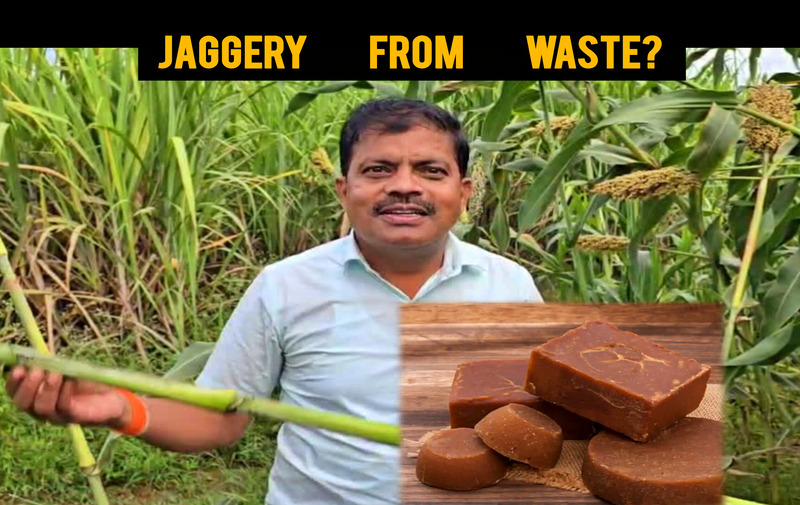
In the farmlands of Bagalkote, Karnataka, Mahalingappa Itnal has done something quietly revolutionary when he looked at agricultural waste and saw possibility. Corn stalks, usually burnt, discarded, or at best fed to cattle after harvest, were long considered the dead end of a crop cycle. But Mahalingappa refused to accept that narrative. Instead, he transformed these fibrous remnants into something both valuable and nourishing: jaggery.
His innovation challenges not just farming practices but mindsets, proving that rural ingenuity, when guided by observation and courage, can rewrite the rules of sustainability. What was once smoke rising from burnt residue is now a source of income, health, and hope.
Mahalingappa’s breakthrough came from a simple but powerful observation: sweet corn stalks contain juice, much like sugarcane. Drawing inspiration from traditional sugarcane jaggery-making techniques, he adapted existing crushing and boiling methods to suit corn stalks. After harvesting the maize grains, instead of discarding the stalks, he crushes them to extract juice. This juice is then filtered, boiled, and reduced using controlled heat until it thickens into jaggery. No complex machinery, no imported technology, just intelligent adaptation of what already existed. By aligning local knowledge with experimentation, he created a process that is efficient, replicable, and farmer-friendly.
The jaggery produced from corn stalks is not just innovative; it is healthier and faster to produce than conventional sugarcane jaggery. Laboratory tests suggest that corn jaggery contains lower sugar levels and higher nutritional value, making it a better alternative, even for people managing diabetes. Beyond health, the efficiency is remarkable.
Corn matures in just four months, half the time required for sugarcane, allowing farmers to grow two crops a year. This reduces water consumption, shortens crop cycles, and lowers financial risk. In an era of climate uncertainty, Mahalingappa’s method offers a resilient and sustainable farming model.
The economic impact of this innovation is equally powerful. By converting what was once agricultural waste into a marketable product, farmers can earn an additional ₹3,000 per tonne, creating a new income stream without increasing land or input costs. Recognised as a first-of-its-kind innovation in India, Mahalingappa Itnal’s work embodies the true spirit of the circular economy, where nothing is wasted, and everything has value.
His journey is not just about jaggery, it is about dignity in farming, intelligence in tradition, and courage in experimentation. In turning corn stalks into gold, Mahalingappa has shown that India’s most transformative innovations often rise quietly from its fields.

Writing about what truly matters, good news and stories to remind the world - it is brighter than we think.