"Dream, Dream, Dream! Conduct these dreams into thoughts, and then transform them into action."
- Dr. A. P. J. Abdul Kalam
"Dream, Dream, Dream! Conduct these dreams into thoughts, and then transform them into action."
- Dr. A. P. J. Abdul Kalam
30 Dec 2025
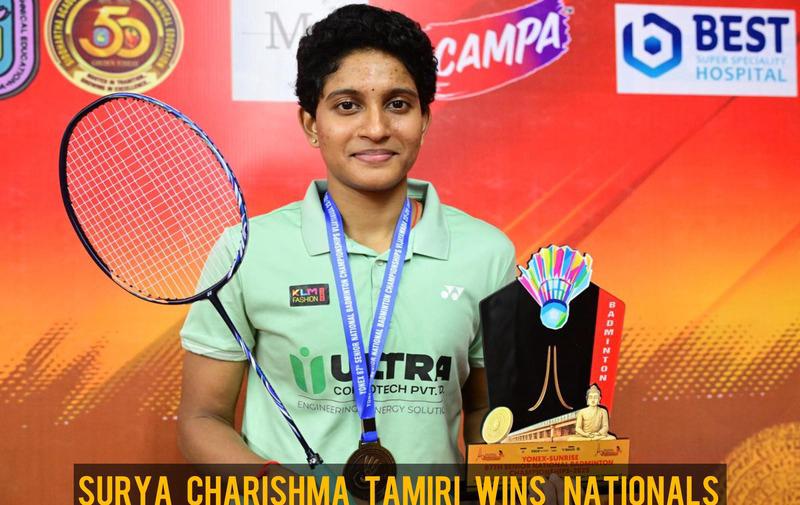
Surya Charishma Tamiri, a 19-year-old badminton prodigy from Vijayawada, etched her name in Indian badminton history by claiming the Women’s Singles crown at the 87th Senior National Badminton Championships held in Vijayawada. Facing a closely contested final against Tanvi Patri, Charishma demonstrated resilience and strategic mastery. After dropping the first game 17–21, she staged a remarkable comeback to win 21–12, 21–14. The victory not only marked a significant milestone in her senior national career but also affirmed her arrival on the national stage, signaling the emergence of a new talent capable of competing at the highest levels.
Charishma’s journey into badminton began at a young age, influenced by her father, Naveen Babu Tamiri, a goldsmith by profession. He recognized her energy and potential early on and enrolled her in a fitness program while she was in UKG. Growing up, Charishma accompanied her father to local badminton courts in Dandamudi, Guntur district, cultivating both skill and passion for the sport. Structured training began in the fourth standard, and by sixth grade, she was practicing with coach K. Bhaskar, under whom she continues to train rigorously. The family’s support has been pivotal in her journey. Naveen Babu prioritized his daughter’s sporting dreams above all else, often pooling personal resources to fund her training and tournament participation. The challenges of financial backing were significant, particularly as Charishma transitioned into the under-19 category without the opportunity to compete internationally. Yet, persistent efforts and small sponsorships from schoolmates and organizations like the Kalamandir Group helped bridge gaps, allowing her to continue developing her game.
A turning point in Charishma’s career came earlier this year when Andhra Pradesh’s IT Minister, Nara Lokesh, extended financial support. Naveen Babu reached out, emphasizing Charishma’s potential to compete at the Olympics given adequate backing. In response, the government released Rs 12,90,000 to aid her training and participation in national and international tournaments. In addition, her college, Chitkara University in Chhattisgarh, has been a crucial pillar of support, providing free admission, flexible exam schedules, and financial assistance, while encouraging her to represent the university in competitions. These interventions highlight the essential role of institutional support in nurturing sporting talent, particularly for young athletes navigating financial and logistical challenges.
Charishma’s success is not merely a product of talent; it is built on discipline, reflection, and meticulous planning. Beyond five hours of daily training, she maintains a personal diary, a practice recommended by the late senior coach Sudhakar Reddy. In it, Charishma records daily training details, match experiences, errors, and lessons learned. This habit has allowed her to analyze performance critically, track improvement, and develop a self-directed learning approach.
While the national title is a significant milestone, Charishma’s focus remains firmly on future goals. She dreams of breaking into the top 100 in international rankings and competing in the Olympics. Facing world-class players such as An Se-young, the current World No. 1, is a challenge she looks forward to, seeing it as an essential experience to hone her skills and gain exposure at the highest level. Her achievements at the senior national level signal not an endpoint but a clear direction toward global competition. The balance of domestic triumphs with strategic international preparation reflects a professional mindset shaped by years of disciplined training, careful planning, and personal resilience. As Surya Charishma Tamiri celebrates her maiden senior national title, the path ahead is filled with both opportunities and challenges. Her story serves as an inspiration to aspiring athletes across India, showing the power of hard work, structured training, and the crucial role of family and institutional support.
Romanticizing life and shaping stories from everything I see through my journalistic lens. Also, I love sports on the side.