"Dream, Dream, Dream! Conduct these dreams into thoughts, and then transform them into action."
- Dr. A. P. J. Abdul Kalam
"Dream, Dream, Dream! Conduct these dreams into thoughts, and then transform them into action."
- Dr. A. P. J. Abdul Kalam
23 Apr 2026
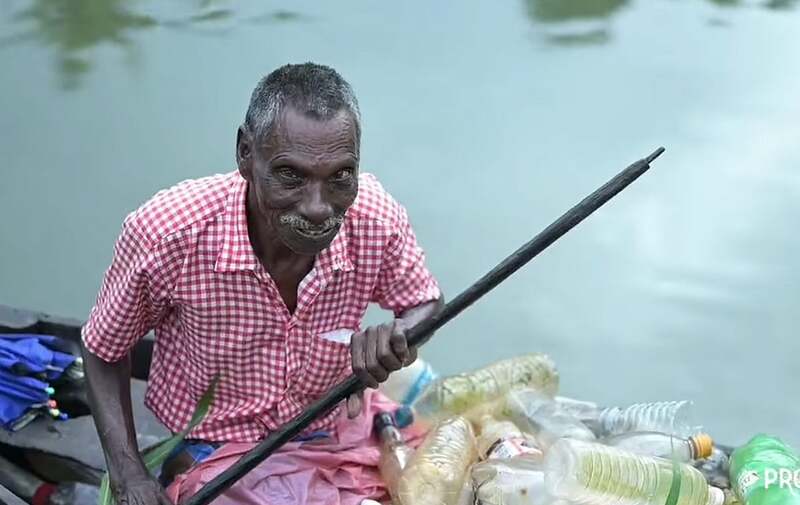
In the serene backwaters of Kerala, where the waters of Vembanad Lake stretch endlessly under open skies, a small country boat moves slowly, guided not by oars in the usual sense, but by the determined hands of a man who refuses to give up. That man is N. S. Rajappan, whose life is a remarkable story of courage, resilience, and purpose. While the world often looks for grand solutions to environmental problems, Rajappan quietly proves that change can begin with a single individual. His journey is not just about cleaning a lake; it is about redefining what it means to serve a cause, even when life presents overwhelming challenges.
Rajappan’s story begins with a struggle that shaped the course of his life. At the age of five, he was affected by polio, leaving him paralyzed below the knees. Mobility, something most people take for granted, became a daily challenge. Yet, instead of allowing his condition to limit him, Rajappan adapted. He learned to move using his hands, finding ways to navigate a world that was not designed for him. Over time, this resilience became a defining part of his character, preparing him for the path he would eventually choose.
For nearly a decade, Rajappan has been dedicated to cleaning plastic waste from the waters of Vembanad Lake and nearby streams in Kerala’s Kottayam district. Every day, he steps into his small boat and ventures into the water, collecting discarded plastic bottles and waste. His method is simple but powerful. Using his hands to row, he moves across the lake, gathering waste that others have left behind. There are no machines, no advanced tools, just determination and a deep sense of responsibility. What drives him is not financial gain. The income he earns from selling collected plastic for recycling is minimal. His motivation comes from a belief that someone must take responsibility for protecting the environment. For Rajappan, that “someone” is himself.
Rajappan’s journey has not been without hardships. During the devastating 2018 Kerala floods, his home was destroyed, leaving him with nowhere to go. For weeks, he lived in his small boat, navigating both physical and emotional challenges. Even after the floods, life remained difficult. Today, he lives alone in a partially damaged hut on a riverbank in Arpookkara panchayat. He depends on his sister’s family for food, yet he continues his work with unwavering commitment. His circumstances could have easily forced him to stop. Instead, they strengthened his resolve.
Rajappan’s work remained largely unnoticed until a local video of his life and efforts went viral on social media. Suddenly, the quiet man in the backwaters became a symbol of dedication and environmental responsibility. His efforts were even acknowledged by Narendra Modi during the popular radio program Mann Ki Baat. This recognition brought national attention to his work, highlighting the impact one individual can have on society. Yet, despite the recognition, Rajappan continues his routine unchanged, focused not on fame but on his mission.
Rajappan’s work goes beyond cleaning plastic waste. It is a powerful statement about responsibility and human potential. In a time when environmental issues often feel overwhelming, his actions remind us that every effort counts. He does not wait for others to act. He does not complain about the scale of the problem. Instead, he does what he can, with what he has, every single day. This simplicity is what makes his story so powerful. At its core, Rajappan’s journey is deeply human. It is about a man who chose purpose over despair, action over inaction, and hope over helplessness. Imagine the physical effort required to row a boat with your hands, day after day.
In a world searching for solutions to environmental challenges, Rajappan’s story offers a simple yet profound lesson. Change does not always require power, resources, or influence. Sometimes, it begins with a single person who refuses to look away. His work encourages us to reflect on our own actions. What can we do, in our own small ways, to protect the environment? How can we contribute to a cleaner, healthier world? His story is not just about environmental conservation. It is about resilience, dignity, and the power of purpose. And in that quiet, persistent effort lies a legacy that will inspire generations to come—a reminder that even in the face of adversity, the human spirit can rise, act, and make a difference.

Writing about what truly matters, good news and stories to remind the world - it is brighter than we think.