"Dream, Dream, Dream! Conduct these dreams into thoughts, and then transform them into action."
- Dr. A. P. J. Abdul Kalam
"Dream, Dream, Dream! Conduct these dreams into thoughts, and then transform them into action."
- Dr. A. P. J. Abdul Kalam
21 Jan 2026
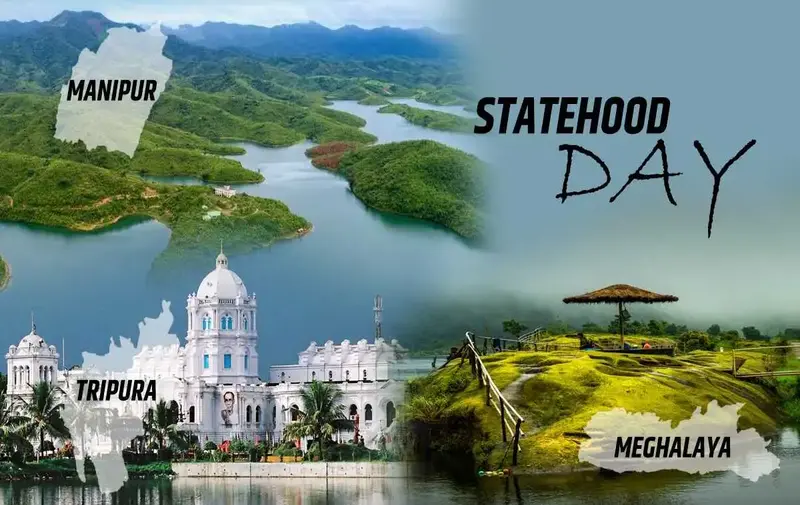
India’s strength has always rested in its ability to hold many identities within one nation. Few dates reflect this spirit as powerfully as 21 January 1972, the day Tripura, Manipur and Meghalaya became full-fledged states of the Indian Union. Celebrated today as Tripura, Manipur and Meghalaya Foundation Day, the occasion is not just about political reorganisation it is about recognition, aspiration and belonging. For the people of these three northeastern states, Foundation Day is deeply personal. It marks the moment their voices found constitutional space, their cultures received formal acknowledgment, and their futures became self-directed within the Indian federal system.
In the years following Independence, India faced the challenge of governing a vast and culturally complex northeastern region. At that time, the region consisted of the Assam plains, hill districts, and princely states such as Manipur and Tripura. While political integration was achieved early, administrative and cultural aspirations remained unfulfilled. Manipur and Tripura, both princely states, merged with India in 1949. However, they were granted Union Territory status in 1956, a move that fell short of the political autonomy their people sought. Meghalaya, on the other hand, was part of Assam but had a distinct tribal and cultural identity. It was first granted autonomous status in 1969, setting the stage for full statehood. The turning point came with the North Eastern Areas Reorganisation Act, 1971, passed by Parliament to address the region’s unique administrative, social and cultural needs. The Act provided the constitutional framework for restructuring the northeast, leading to the historic moment of statehood on 21 January 1972.
The formation of Tripura, Manipur and Meghalaya was carried out under the 27th Constitutional Amendment Act, reflecting India’s commitment to cooperative federalism. This reorganisation was not merely about redrawing boundaries; it was about empowering people. With statehood came full legislative and executive powers, enabling locally rooted governance and development planning. The Act ensured that these states could protect their cultural heritage while participating equally in national growth. It was a decisive step towards inclusive nation-building.
Manipur’s journey to statehood is intertwined with its ancient identity as Kangleipak. Known for its classical dance form, vibrant festivals and martial traditions, Manipur holds a unique place in India’s cultural map. Its strategic location bordering Myanmar makes it a natural bridge between South Asia and Southeast Asia. Statehood allowed Manipur to shape policies aligned with its social fabric, strengthening education, sports and cultural preservation. Today, Manipuri dancers, athletes and artists carry the state’s legacy to national and global platforms, making Foundation Day a reminder of resilience and pride.
Tripura’s history is marked by the long reign of the Manikya dynasty, whose influence still echoes in landmarks such as the Ujjayanta Palace. The state is equally shaped by its rich tribal heritage, particularly the Kokborok-speaking Tripuri communities. After merging with India in 1949 and spending years as a Union Territory, Tripura achieved statehood in 1972. This transition strengthened tribal representation and cultural revival. Today, Tripura stands out for its bamboo crafts, indigenous art and growing role in sustainable development, making Foundation Day a celebration of both tradition and transformation.
Carved out of Assam, Meghalaya derives its name from Sanskrit, meaning “abode of clouds.” Home to the Khasi, Jaintia and Garo tribes, the state reflects a rare blend of indigenous traditions and colonial influences. Known for its matrilineal society, living root bridges, caves and rainfall-rich landscapes like Cherrapunji and Mawsynram, Meghalaya became a state in 1972 after gaining autonomy in 1969. Statehood gave its people greater control over land, culture and governance, ensuring that development did not come at the cost of identity.
The Tripura, Manipur and Meghalaya Foundation Day 2026 marks 54 years of statehood. Across Imphal, Agartala and Shillong, the day will be observed with cultural programs, traditional dances, music and public events. Celebrations reflect not only history but also progress—highlighting achievements in education, infrastructure and governance. Observed under the spirit of Ek Bharat Shreshtha Bharat, Foundation Day also promotes cultural exchange, reminding the nation that unity grows stronger when diversity is respected. Economically, bamboo industries, organic farming and eco-tourism are opening new opportunities, while their strategic location places them at the heart of India’s Act East Policy, strengthening ties with Southeast Asia.
The Tripura, Manipur and Meghalaya Foundation Day is more than an anniversary; it is a reminder of India’s inclusive journey. It honours the courage of communities who preserved their identity while embracing nationhood. As the tricolour rises on 21 January 2025, it carries with it stories from the hills, valleys and clouds of the Northeast—stories of people who waited to be heard and who today stand firmly as equal partners in India’s democratic dream.
Romanticizing life and shaping stories from everything I see through my journalistic lens. Also, I love sports on the side.