"Dream, Dream, Dream! Conduct these dreams into thoughts, and then transform them into action."
- Dr. A. P. J. Abdul Kalam
"Dream, Dream, Dream! Conduct these dreams into thoughts, and then transform them into action."
- Dr. A. P. J. Abdul Kalam
29 Jan 2026
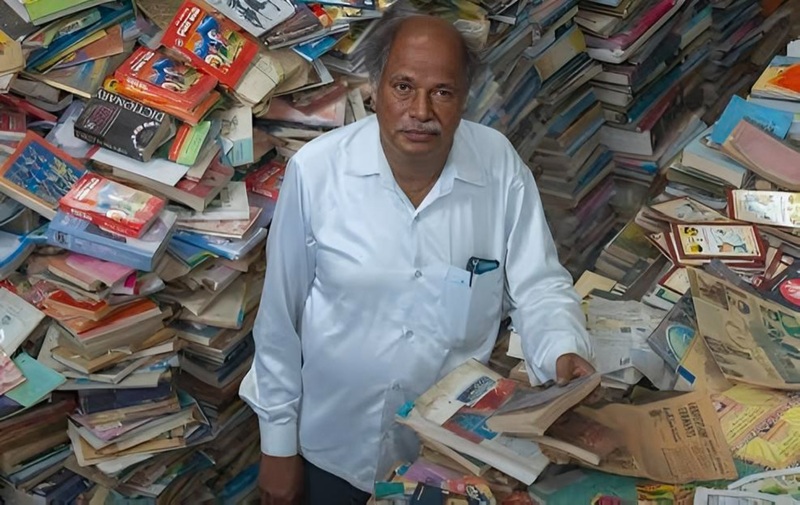
In a country that often celebrates loud success, this story begins in silence—the soft rustle of pages, the smell of old paper, and a man who spent five decades working without expecting applause. On the eve of Republic Day 2026, when the Padma Awards list was announced, one name stood out not for glamour or power, but for humility. Anke Gowda, a former bus conductor from a small village in Karnataka, was conferred the Padma Shri. His reward was not for fame or fortune, but for building something India and the world had never seen before: the largest free-access library on Earth.
Born in 1951 into a farming family in Chinakurli village of Mandya district, Anke Gowda grew up with limited access to books. In rural Karnataka, books were not everyday companions but rare luxuries. Yet, somewhere between the fields and village life, a quiet curiosity took root. His real awakening came during his college years, when a professor encouraged him to read deeply and widely. That encouragement lit a fire that would guide every decision of his life.
Gowda earned his living as a bus conductor, punching tickets on dusty routes while life rushed past him in fleeting faces and destinations. By evening, he transformed into a student, pursuing a B.A. and later an M.A. in Kannada literature. His love for books was not academic ambition alone; it was emotional, almost spiritual. At the age of 20, while still working as a conductor, he began collecting books, one here, another there, unaware that he was laying the foundation for a global record.
The collection grew slowly but relentlessly. Gowda later worked at the Pandavapura Cooperative Sugar Factory, where nearly 80 percent of his salary went directly into buying books. He sold a plot in Mysuru, invested his retirement benefits of about Rs 33 lakh, used bonuses, and even sold his house, all for books. Possessions were exchanged for pages, comfort for knowledge. His wife, Vijayalakshmi, stood by him through these sacrifices, and today the couple lives modestly on the library premises itself.
In Haralahalli village of Pandavapura taluk stands Pustaka Mane, meaning “House of Books.” It is not just a building but a living archive of human thought. Housing over 20 lakh books in more than 20 languages, it includes literature, science, mythology, philosophy, and sacred texts from across the world. The collection features rare manuscripts dating back to 1832, nearly 5,000 dictionaries, 35,000 international magazines, 2,500 books on Mahatma Gandhi, another 2,500 on the Bhagavad Gita, and even religious texts like the Bible. In 2016, the Limca Book of Records recognised it for its staggering scale.
From attending 37 Sahitya Sammelanas to personally managing the library with his son Sagar, his dedication never wavered. Challenges were constant: lack of funds, space constraints, and minimal staff, yet his purpose remained clear: preserve knowledge for future generations.
Anke Gowda is among 45 “unsung heroes” honoured with Padma Awards in 2026.
The government highlighted how these individuals overcame personal hardships to serve society quietly. From doctors addressing local health challenges to artists preserving dying traditions, this year’s awardees reflect everyday Indians devoted to Bharat Mata. Alongside prominent names like Alka Yagnik, Rohit Sharma, and Harmanpreet Kaur, Gowda’s inclusion reminds the nation that service does not always wear a spotlight.
Anke Gowda’s journey is deeply human. It is about a man who chose pages over possessions, patience over praise, and service over success. From a bus conductor’s uniform to the Padma Shri medal, his life proves that true impact is often built quietly, one book at a time. In the stillness of Pustaka Mane, among millions of stories, lives one story that will inspire generations: the story of a man who believed that knowledge belongs to everyone.
Romanticizing life and shaping stories from everything I see through my journalistic lens. Also, I love sports on the side.