"Dream, Dream, Dream! Conduct these dreams into thoughts, and then transform them into action."
- Dr. A. P. J. Abdul Kalam
"Dream, Dream, Dream! Conduct these dreams into thoughts, and then transform them into action."
- Dr. A. P. J. Abdul Kalam
28 Jan 2026
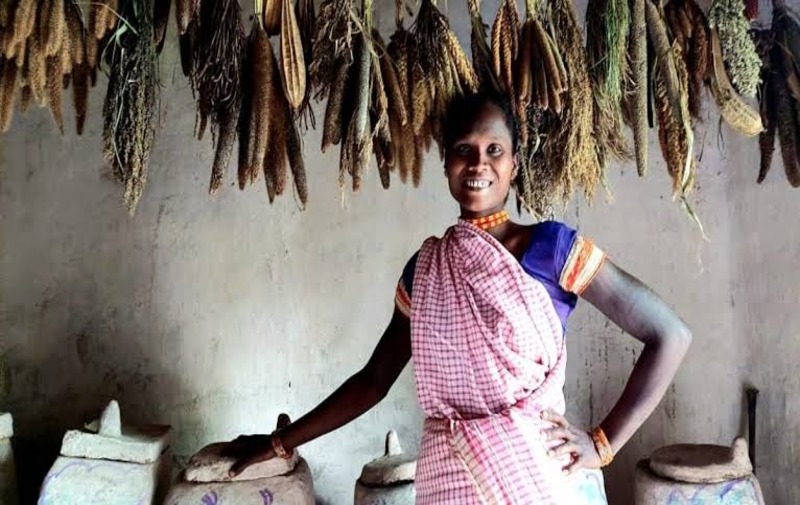
In an age where agriculture is increasingly driven by chemicals, commercial seeds, and uniform crops, Lahari Bai stands out as a quiet revolutionary. From the remote Dindori district of Madhya Pradesh, this humble farmer has dedicated her life to protecting something most people overlook: traditional seeds. Known today as the ‘Millets Queen’ of Madhya Pradesh, Lahari Bai is on a mission to conserve India’s disappearing millet diversity and revive farming practices that are deeply connected to nature, nutrition, and culture. Her journey is not backed by laboratories, big funding, or formal education in agricultural science. Instead, it is rooted in inherited wisdom, lived experience, and an unshakeable belief that seeds are not just food but life itself.
Lahari Bai’s connection with agriculture began early in life. Born and raised in a farming family, she grew up watching her grandmother carefully preserve seeds from each harvest. These seeds were treated with respect, dried, stored, and protected like family treasures. For Lahari, this was not a lesson taught in words, but one learned by observing daily life. Inspired by her grandmother, Lahari began collecting seeds when she was just 18 years old. At a time when most young people dream of leaving villages behind, she chose to walk deeper into fields and forests. She understood instinctively that traditional grains were slowly disappearing, replaced by market-driven crops that promised quick yields but weakened biodiversity.
Why Millets Are a Healthy Choice
Millets are small grains packed with big health benefits. They are rich in fiber, protein, vitamins, and minerals like iron and calcium. Unlike polished rice or refined wheat, millets are eaten in a more natural form, which helps keep their nutrients intact. Millets are easy to digest and help control blood sugar levels, making them a good option for people with diabetes. They also support heart health, improve gut health, and help in weight management. Including millets in daily meals leads to a healthier and more balanced diet.
Millets became the heart of Lahari Bai’s work. Small millets, once staples in tribal and rural diets, had been pushed aside by rice and wheat. Yet these grains are climate-resilient, nutritious, and perfectly suited to India’s diverse geography. Over the years, Lahari has collected and conserved nearly 150 varieties of traditional millet seeds. Some of them are so rare that even local farmers had forgotten their names. Varieties like Kodu, Kutki, Sikiya, Silhar, Sava, and Chen now survive because of her efforts. She stores these seeds in her own seed bank, carefully maintaining them season after season. This seed bank is not a formal institution but a living archive built with patience, trust, and deep ecological understanding.
Lahari Bai’s work is not confined to her own farm. She spends much of her time visiting nearby villages and forest regions, searching for forgotten grains. She speaks to elderly farmers, tribal communities, and forest dwellers, asking them about crops they once grew. Often, people laugh at her curiosity. In the early days, many mocked her for collecting “useless” seeds that had no market value. But Lahari persisted. She believed that food security and biodiversity were more important than short-term profit. Alongside seed conservation, she also collects forest produce, which she sells in local markets to earn a living. Her life is simple, but her purpose is vast.
One of Lahari Bai’s most impactful contributions is seed distribution. She does not hoard her collection. Instead, she freely shares seeds with local farmers, encouraging them to grow traditional millets again. By doing so, she promotes agricultural diversity, soil health, and climate resilience. Farmers who once depended entirely on commercial seeds are slowly rediscovering crops that need less water, fewer inputs, and offer better nutrition. When people saw Lahari cooking meals from her own millet harvest—healthy, filling, and deeply rooted in tradition—skepticism turned into admiration. What was once laughed at became something to envy. Lahari Bai’s work eventually gained attention beyond her village. Journalists, researchers, and agricultural experts began visiting her, curious about her seed bank and knowledge of traditional grains.
As India and the world rethink food systems, Lahari Bai’s work offers a powerful lesson: sustainability does not always come from innovation alone, but from preservation. In her mud-stored seed bank lies a blueprint for future farming: diverse, local, and resilient. Lahari Bai may be called the ‘Millets Queen’, but her real crown is the trust of farmers and the survival of seeds that might otherwise have vanished forever.
Lahari Bai’s life teaches us that we should not forget our roots while moving ahead. She shows that old knowledge and traditional farming are very important for our future. By saving millet seeds, she proves that even one person can protect nature and help many people. Her story reminds us to respect farmers, care for the environment, and think about long-term benefits, not just quick profit. Lahari Bai teaches us that small efforts, when done with honesty and patience, can bring big and lasting change.
Romanticizing life and shaping stories from everything I see through my journalistic lens. Also, I love sports on the side.