"Dream, Dream, Dream! Conduct these dreams into thoughts, and then transform them into action."
- Dr. A. P. J. Abdul Kalam
"Dream, Dream, Dream! Conduct these dreams into thoughts, and then transform them into action."
- Dr. A. P. J. Abdul Kalam
6 Feb 2026
Teaching is the quiet profession behind every loud success. Doctors, engineers, artists, scientists, and leaders—none exist without a teacher standing somewhere in the background, shaping minds with patience and belief. It is often called the most respected job in the world, not because of awards or applause, but because it plants seeds that grow long after the lesson ends. The world paused to honour that truth.
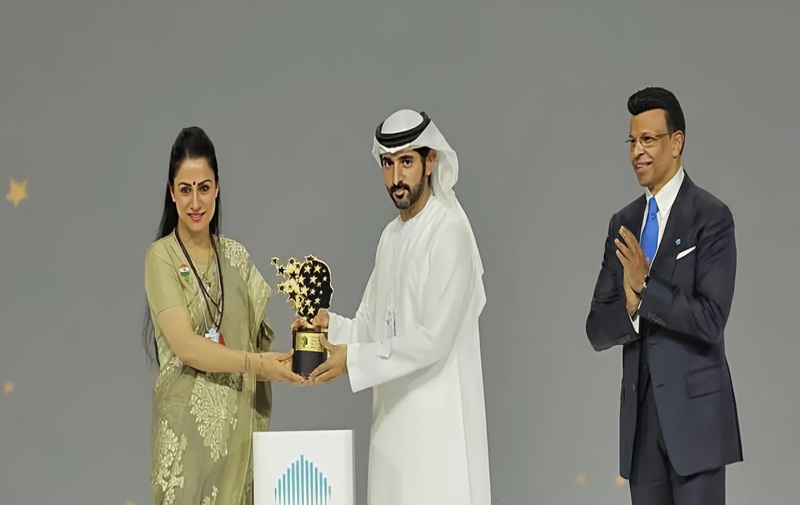
At the World Governments Summit in Dubai, Indian educator and social reformer Rouble Nagi was awarded the prestigious $1 million Global Teacher Prize 2026, often described as the “Nobel of Teaching.” Presented by Dubai’s Crown Prince Shaikh Hamdan bin Mohammad bin Rashid Al Maktoum, the award recognised a woman who turned walls into classrooms and forgotten children into learners.
Mumbai-based Rouble Nagi became India’s latest global education icon as she received the GEMS Education Global Teacher Prize, joining an elite list of educators whose work has transformed lives against overwhelming odds. The Global Teacher Prize celebrates teachers who make an extraordinary impact on their communities, often with limited resources but unlimited compassion. Her win was widely celebrated across India, especially in Jammu and Kashmir, her home region, where many hailed her as a “daughter of the soil” who carried local values of resilience and service onto the world stage. Praise also poured in from past Global Teacher Prize winner Ranjitsinh Disale, who acknowledged her work as a powerful reminder of what education can achieve when it reaches the last child.

Rouble Nagi’s story is unlike that of conventional educators. An internationally acclaimed artist with over 800 murals and more than 150 exhibitions worldwide, she chose not to keep her art confined to galleries. Instead, she carried it into narrow lanes, slums, and villages—places where classrooms were missing, but curiosity was alive. Through her Rouble Nagi Art Foundation, she pioneered the concept of “Living Walls of Learning.” Instead of blackboards and textbooks, she painted alphabets, numbers, scientific concepts, historical figures, and moral lessons directly onto walls. These murals transformed dull, broken structures into vibrant learning spaces where children could read, count, and imagine. Over two decades, this idea grew into a nationwide movement.

What began as an artistic experiment evolved into one of India’s most innovative education models. Rouble Nagi has helped establish more than 800 learning centres across slums and rural areas, reaching over one million children many of whom had never stepped inside a school. These centres support both out-of-school children and those already enrolled in government schools but struggling with foundational learning. The aim is simple yet powerful make education visual, accessible, and joyful. Literacy, mathematics, science, and history become easier when learning feels familiar and close to home.
Today, the foundation operates in over 163 slums and villages across India, delivering education through low-cost, sustainable models that communities themselves can maintain. Education, for Rouble Nagi, was never just about books. It was about dignity. Through the Misaal Mumbai initiative, she led the repair and painting of more than 1,50,000 homes, turning neglected settlements into colourful, safe, and hopeful neighbourhoods.
The Global Teacher Prize jury recognised Rouble Nagi not only for numbers but also for impact. More than 800 learning centres. More than 800 educational murals. More than a million lives touched. But beyond statistics lies a deeper truth: she reached children the system had forgotten. Her work proved that education does not always need buildings, budgets, or bureaucracy. Sometimes, it just needs a wall, a brush, and belief. With the $1 million prize money, Rouble Nagi plans to expand her learning centres, train more teachers, and establish a free Skilling Institute. The goal is to provide vocational training to young people so they can become self-reliant and secure dignified employment. In a country where millions of youth struggle to transition from education to jobs, this next step bridges a crucial gap. It ensures that learning does not end at literacy but leads to livelihood.
The Global Teacher Prize has previously honoured a Kenyan teacher who donated most of his earnings to the poor, a Palestinian educator teaching non-violence, and a Canadian teacher working with Inuit students in remote Arctic villages. In 2025, Saudi educator Mansour Al-Mansour won for his work with the poor in the UAE. In 2026, Rouble Nagi’s name joined this list not as just an Indian winner, but as a global symbol of what teaching can be when it reaches beyond classrooms.
Rouble Nagi’s story reminds us that teaching is not limited by chalk or classrooms. It is an act of faith in humanity. By turning walls into teachers and art into education, she has shown the world that the most respectful job on Earth still has the power to quietly change everything. And sometimes, the strongest lessons are painted, not spoken.
Romanticizing life and shaping stories from everything I see through my journalistic lens. Also, I love sports on the side.