"Dream, Dream, Dream! Conduct these dreams into thoughts, and then transform them into action."
- Dr. A. P. J. Abdul Kalam
"Dream, Dream, Dream! Conduct these dreams into thoughts, and then transform them into action."
- Dr. A. P. J. Abdul Kalam
28 Jan 2026
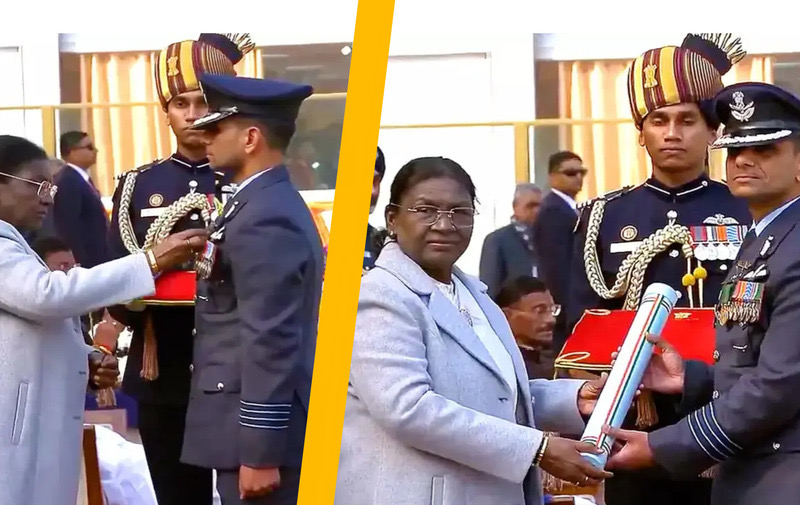
On India’s Republic Day 2026, history quietly expanded its definition of courage. President Droupadi Murmu conferred the Ashoka Chakra, the nation’s highest peacetime gallantry award, on Group Captain Shubhanshu Shukla of the Indian Air Force, not for an act on the battlefield, but for an extraordinary mission far beyond Earth’s atmosphere.
The Ashoka Chakra is traditionally reserved for acts of exceptional bravery, selflessness, and presence of mind in life-threatening situations. By awarding it to an astronaut, India acknowledged a powerful truth: courage is not limited to borders or battlefields. Sometimes, it is found in the unforgiving vacuum of space.
Shukla’s honour marked a rare moment in Indian history. He became one of the very few individuals to receive the Ashoka Chakra for a mission rooted in scientific exploration, yet fraught with immense physical, psychological, and technical risk.
Group Captain Shubhanshu Shukla’s selection for a human space mission placed him among the most elite professionals in the country. In June 2025, he flew aboard SpaceX’s Dragon spacecraft as part of Axiom Mission 4, journeying to the International Space Station (ISS). With this mission, he became the first Indian to enter the ISS and only the second Indian to travel to space.
During his 18-day stay aboard the ISS, Shukla conducted and supported over 60 scientific experiments, including several designed by Indian researchers and ISRO. These studies explored human health in microgravity, material behaviour in space, and biological processes that could transform medicine and technology on Earth.
His calm execution, operational discipline, and ability to work across international teams under extreme conditions formed the backbone of the mission’s success, qualities that align closely with the spirit of the Ashoka Chakra.
Born in Lucknow and commissioned into the Indian Air Force in 2006, Shubhanshu Shukla built his career in the cockpit long before he reached orbit. A graduate of the National Defence Academy, he trained as a fighter pilot and later a test pilot, flying a wide range of frontline aircraft. Over the years, he accumulated more than 2,000 hours of flying experience, a testament to both skill and endurance.
In 2019, he was selected for India’s astronaut training program, a process defined by intense physical conditioning, psychological evaluation, and advanced technical training, both in India and abroad. Only those capable of handling prolonged stress, isolation, and split-second decision-making are chosen.
What sets Shukla apart is not just technical excellence but temperament, the quiet resilience required when Earth is no longer beneath your feet.
By honouring Shubhanshu Shukla, India has redefined gallantry for the modern age, recognising bravery in exploration, science, and national advancement. Recipients of the Ashoka Chakra receive lifelong respect, official privileges, and financial benefits, but its greatest value lies in legacy. Shukla’s achievement strengthens India’s human spaceflight ambitions, directly contributing to future missions such as Gaganyaan and beyond.
Group Captain Shubhanshu Shukla’s Ashoka Chakra is not just an award for what he accomplished in space. It is recognition of the bravery it takes to go where no Indian has gone before, carrying the weight of a nation’s dreams, silently, steadily, and without fear.

Writing about what truly matters, good news and stories to remind the world - it is brighter than we think.