"Dream, Dream, Dream! Conduct these dreams into thoughts, and then transform them into action."
- Dr. A. P. J. Abdul Kalam
"Dream, Dream, Dream! Conduct these dreams into thoughts, and then transform them into action."
- Dr. A. P. J. Abdul Kalam
15 Dec 2025
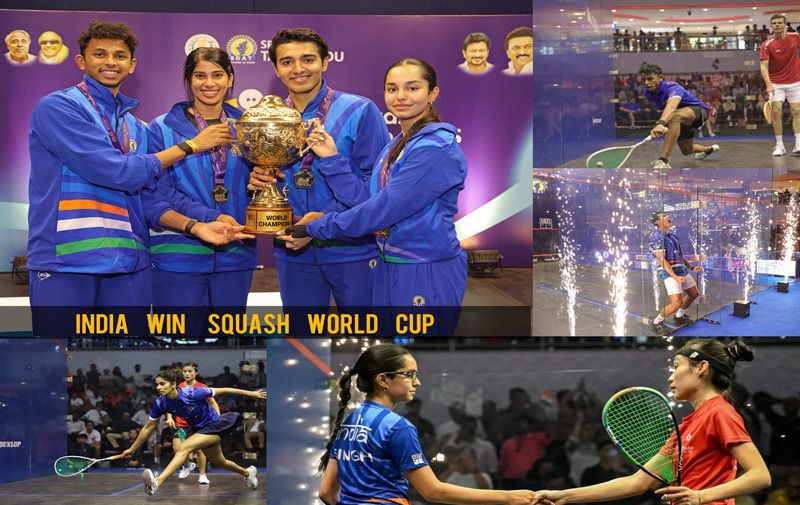
On a warm evening in Chennai, Indian squash found its defining moment. Under bright lights and rising expectations, India defeated top seeds Hong Kong China 3-0 to lift the Squash World Cup 2025, their first title in the tournament’s history. With that victory, India also became the first Asian nation to win the Squash World Cup and only the fourth overall after Australia, England, and Egypt. It was more than a trophy. It was a statement of belief, depth, and a future that now looks brighter than ever for Indian squash.
India arrived at the 2025 edition as the second seeds, carrying memories of a bronze-medal finish in 2023. That podium result had hinted at potential, but what unfolded in Chennai was dominance of the highest order. The group stage saw India dismantle Switzerland and Brazil by identical 4-0 margins, showcasing balance across men’s and women’s matches. In the knockout rounds, the challenge stiffened, but India rose higher. South Africa were brushed aside 3-0 in the quarterfinals, followed by an emphatic 3-0 victory over two-time champions Egypt in the semifinals, a result that turned heads across the squash world. By the time India walked into the final, belief had replaced pressure.
Standing between India and history was Hong Kong China, the tournament’s top seeds and a side known for its discipline and consistency. Finals often magnify nerves, but the Indian players looked calm, composed, and purposeful from the very first rally. Veteran Joshna Chinappa set the tone. Ranked 79th in the world, she faced the higher-ranked world No. 37 Lee Ka Yi in the opening women’s singles rubber. Drawing on years of experience and tactical intelligence, Joshna absorbed pressure, changed pace beautifully, and stunned her opponent 3-1. That opening win did more than put India ahead; it injected confidence into the entire team.
If Joshna provided experience, Abhay Singh delivered authority. India’s top-ranked men’s singles player at world No. 29, Abhay looked in complete control against Alex Lau, ranked 42nd. His movement was sharp, his shot selection precise, and his intent clear from the first point. Winning 3-0 in just 19 minutes, Abhay gave India a commanding 2-0 lead. His performance reflected the quiet confidence of a player who understands responsibility and thrives under it.
With the title on the line, all eyes turned to 17-year-old Anahat Singh. The youngest player on court, she carried the biggest moment of her career so far. Facing world No. 31 Tomato Ho, Anahat showed maturity well beyond her years. Ranked 28th herself, Anahat played fearless squash, attacking when needed, defending patiently, and refusing to let the occasion overwhelm her. Her straight-games victory sealed the tie, the title, and a place in Indian sporting history. As the final point was won, emotion spilled onto the court. Tears, smiles, and embraces told a story of dreams realized. Velavan Senthilkumar never had to step on court for the final rubber, but his presence throughout the tournament underlined the squad’s depth.
How the Squash World Cup Turns an Individual Game into a Team Battle
At the Squash World Cup, squash is played as a team sport rather than an individual event. Each country fields a mixed team of two men and two women. In a tie, teams play up to four singles matches, called rubbers. Each match is played in a best-of-five format, with every game going to seven points. In the final, the team that wins three matches first is declared the champion, so the tie can end 3–0 before all matches are played. If teams are tied, the winner is decided by overall game difference. good title to it
This victory made India only the fourth nation to win the Squash World Cup in its five editions, a remarkable feat considering the tournament’s long history since its inception in 1996. That the triumph came in Chennai, hosting the event for the third consecutive time, made it even more special for players and fans alike. The format of the Squash World Cup, with mixed teams of two men and two women, demands balance and unity. India’s success reflected exactly that: a seamless blend of youth and experience, men and women, and calm and aggression.
India’s maiden Squash World Cup title arrives at a crucial time. With squash set to make its Olympic debut at the LA 2028 Games, this victory signals India’s readiness to compete at the very top on the global stage. For young players watching from across the country, Anahat Singh’s rise offers hope. For veterans like Joshna Chinappa, the win is validation of years spent building the sport brick by brick. And for Indian squash as a whole, this title marks the beginning of a new era, one built on belief, preparation, and fearlessness.

Writing about what truly matters, good news and stories to remind the world - it is brighter than we think.