"Dream, Dream, Dream! Conduct these dreams into thoughts, and then transform them into action."
- Dr. A. P. J. Abdul Kalam
"Dream, Dream, Dream! Conduct these dreams into thoughts, and then transform them into action."
- Dr. A. P. J. Abdul Kalam
28 Jan 2026
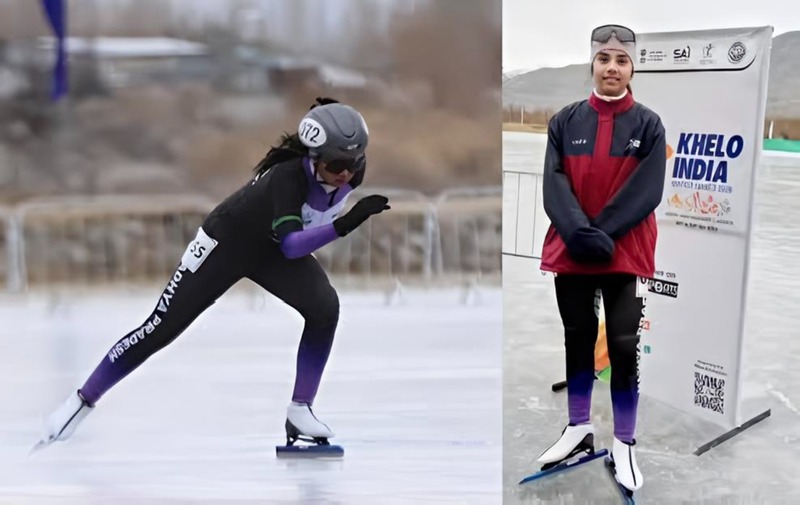
On a frozen pond beside the Indus River, amid biting winds and sub-zero temperatures, a quiet but powerful moment unfolded for Indian sport. As the stopwatch stopped at 53.94 seconds, a 15-year-old girl from Satna district in Madhya Pradesh etched her name into the record books. Udreka Singh, a Class 11 student from Maihar, had just become India’s fastest female ice skater, winning gold in the Women’s Long Track 500m event at the Khelo India Winter Games 2026. In a country where winter sports are still finding their footing and where ice skating is often associated with faraway cold regions, Udreka’s achievement stands out not just for the medal she won but for the barriers she broke along the way.
The Khelo India Winter Games 2026 were held from January 20 to 26 in Leh-Ladakh, one of the toughest environments for competitive sport. The Women’s Long Track 500m race took place at Gupukh’s Pond, a naturally frozen water body located beside the Indus River. Skating here is vastly different from controlled indoor rinks. Athletes must battle uneven ice, thin air at high altitude, freezing winds, and constant temperature fluctuations. Against this backdrop, Udreka delivered a composed and technically sharp race. Her winning time of 53.94 seconds not only earned her the gold medal but also established her as the fastest Indian woman in the discipline. She finished ahead of Ladakh’s local favorite, Skarma Tsultim, who clocked 54.21 seconds for silver, while Tasnia Shameem, also from Ladakh, took bronze with 57.41 seconds.
What makes Udreka’s victory even more remarkable is the fact that this race was her first competitive outing using long-track boots and blades. Long track ice skating demands a completely different skating posture, balance, and stride compared to short track formats. For most athletes, adapting to new equipment at a national-level event would be daunting. Yet, Udreka skated with maturity beyond her years. Her clean corners, powerful push-offs, and controlled speed reflected not just raw talent but deep discipline and adaptability. Outpacing skaters who train regularly in icy regions, she proved that learning curves can be conquered with focus and courage.
Udreka Singh’s story is deeply human and quietly inspiring. Hailing from Maihar, a small town in Satna district, she did not grow up surrounded by ice rinks or winter sports culture. Access to specialized facilities, equipment, and elite coaching was limited. What she did have was determination, supportive mentors, and an unwavering belief that her background would not define her limits. This was her third appearance at the Khelo India Winter Games, and her steady improvement over the years reflects a journey built on patience and persistence. Each edition sharpened her skills, strengthened her confidence, and prepared her for the breakthrough that finally arrived in 2026. For a teenager balancing academics and high-performance sport, the sacrifices have been real: early mornings, long travel hours, physical exhaustion, and the mental pressure of competition. Her gold medal is not just a sporting achievement; it is the reward for years of unseen effort.
Traditionally, Indian winter sports have been dominated by regions with natural ice and cold climates, such as Ladakh, Himachal Pradesh, and Jammu & Kashmir. Udreka’s success challenges that narrative. Her win signals the emergence of Madhya Pradesh as an unlikely but promising contributor to winter sports. Her achievement has sparked pride across Satna, Maihar, and the wider state, inspiring young athletes—especially girls—to dream beyond conventional boundaries. She has become a symbol of what is possible when opportunity meets preparation, regardless of geography.
At just 15, Udreka Singh carries the hopes of a new generation of Indian winter athletes. Her gold medal is not an end point but a beginning of greater ambitions, tougher competitions, and possibly international podiums in the future. For young girls watching from small towns and modest backgrounds, her story sends a powerful message: your starting point does not decide your finish line. On a frozen pond thousands of kilometers away from home, Udreka Singh didn’t just race against time; she raced against limitations and won.
Romanticizing life and shaping stories from everything I see through my journalistic lens. Also, I love sports on the side.