"Dream, Dream, Dream! Conduct these dreams into thoughts, and then transform them into action."
- Dr. A. P. J. Abdul Kalam
"Dream, Dream, Dream! Conduct these dreams into thoughts, and then transform them into action."
- Dr. A. P. J. Abdul Kalam
2 Apr 2026
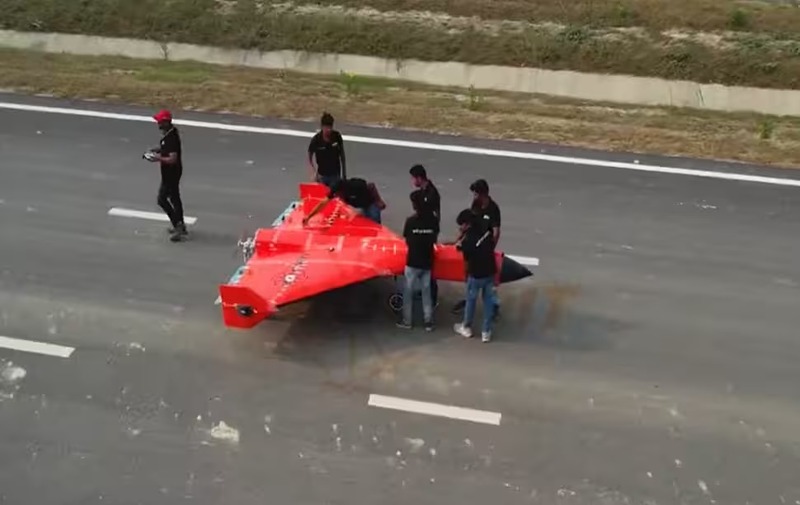
A startup from Lucknow is making waves in the world of defence technology. HoverIt has successfully conducted high-speed taxi trials of its long-range loitering munition, Divyastra MK2—an advanced unmanned system capable of striking targets up to 2,000 kilometres away. This achievement is not just about technology. It represents a shift in India’s defence landscape, where innovation is no longer limited to large public-sector institutions but is increasingly driven by agile, ambitious startups.
The Divyastra MK2 is not an ordinary drone. It is a next-generation loitering munition—often referred to as a “kamikaze drone”—designed to hover over a target area before striking with precision. What sets it apart is its impressive range of up to 2,000 km, placing it in the category of deep-strike platforms. This allows it to target adversarial infrastructure far beyond frontline zones, offering strategic advantages in modern warfare. Equipped with advanced navigation systems like visual-inertial odometry and terrain-relative navigation, the MK2 can operate even in GPS-denied or electronically jammed environments. In today’s era of electronic warfare, this capability is crucial.
HoverIt’s earlier platform, Divyastra MK1, was already a capable system with a range of around 500 km and a 15 kg payload. But the MK2 represents a massive leap forward. With enhanced payload capacity, extended endurance, and a fourfold increase in range, the MK2 transitions from a tactical tool to a strategic asset. It bridges a critical gap between short-range drones and expensive cruise missiles, offering a cost-effective yet powerful alternative. This evolution reflects a broader trend in defence technology moving towards smarter, more flexible, and more autonomous systems.
Behind this technological breakthrough is a team of passionate professionals. Ravinder Singh, Saurav Singh Bhadauria, and Pawan Pandey founded HoverIt with a clear vision to build mission-ready UAVs tailored for real-world defence needs. Operating under KAWA UAV Pvt. Ltd., the company combines expertise in engineering, military operations, and design. Their focus has always been practical deployment rather than experimental innovation, ensuring that their systems are not just advanced but also reliable.
HoverIt is not limited to a single innovation but has built a strong and diverse portfolio of unmanned aerial systems tailored for multiple defence and security needs. Its earlier platform, Divyastra MK1, serves as a multi-role loitering munition equipped with swarm capabilities, allowing coordinated operations for enhanced effectiveness. Alongside this, the Baaz drone is designed for tactical missions, capable of precise payload delivery even in high-altitude conditions. The Raftaar UAV adds another dimension with its fixed-wing design and vertical take-off and landing (VTOL) capability, making it ideal for long-range surveillance without requiring runways. Meanwhile, Aankh stands out as a compact intelligence, surveillance, and reconnaissance (ISR) drone, integrated with thermal imaging and AI-driven analytics for real-time insights. These systems are not just theoretical concepts but have been rigorously tested in real-world scenarios, including high-altitude deployments in Ladakh and complex surveillance missions across challenging terrains, proving their reliability and operational readiness.
HoverIt operates from the Uttar Pradesh Defence Industrial Corridor, a hub designed to boost indigenous defence manufacturing. Its work aligns closely with India’s “Make in India” and “Atmanirbhar Bharat” initiatives, which aim to reduce dependence on foreign defence imports. By developing advanced systems domestically, companies like HoverIt are strengthening India’s self-reliance while also contributing to its global competitiveness.
The successful high-speed taxi trials are just the beginning. The next steps include full flight testing, system validation, and eventual operational deployment. HoverIt is also working on integrating its systems into a larger capability stack, including swarm coordination and multi-platform operations. This points towards a future where drones work together seamlessly, enhancing efficiency and effectiveness. As the company prepares to scale manufacturing, it is positioning itself at the forefront of India’s private defence innovation wave.
India’s defence needs are evolving rapidly. Modern warfare is no longer just about numbers; it is about technology, precision, and adaptability. The development of systems like Divyastra MK2 ensures that India is not just keeping pace with global advancements but is also contributing to them. It also highlights the growing role of startups in national development. These companies bring fresh ideas, speed, and innovation, complementing traditional defence institutions.
HoverIt’s journey from building surveillance drones to developing long-range strike systems is a story of ambition, innovation, and national pride. The Divyastra MK2 is more than a technological achievement it is a symbol of what India can achieve when talent, vision, and opportunity come together. As the drone moves from trials to reality, it carries with it the hopes of a nation striving to be stronger, smarter, and self-reliant. Because sometimes, the future of defence is not built in massive factories but in the dreams of a few determined minds.

Romanticizing life and shaping stories from everything I see through my journalistic lens. Also, I love sports on the side.