"Dream, Dream, Dream! Conduct these dreams into thoughts, and then transform them into action."
- Dr. A. P. J. Abdul Kalam
"Dream, Dream, Dream! Conduct these dreams into thoughts, and then transform them into action."
- Dr. A. P. J. Abdul Kalam
4 Jan 2026
President of India Smt Droupadi Murmu sent out a powerful message from the Rashtrapati Bhavan Cultural Centre: for a young nation like India, Artificial Intelligence is not merely a new technology but a transformative opportunity for positive change. While launching the #SkillTheNation AI Challenge under the SOAR (Skilling for AI Readiness) initiative of the Ministry of Skill Development and Entrepreneurship (MSDE), the President underlined how AI is reshaping economies, societies, and the very way humans learn, work, and solve problems. India, with its vast youth population and growing digital ecosystem, stands at a crucial crossroads. The President’s words reflected both optimism and responsibility—optimism about what AI can do for India and responsibility to ensure that this powerful tool benefits everyone, not just a few.
The #SkillTheNation AI Challenge is part of the SOAR initiative, which aims to prepare India’s workforce for an AI-driven future. The program focuses on building readiness in key areas such as data science, AI engineering, and data analytics skills that are rapidly becoming essential across industries. By launching this challenge, the government has signaled a shift from merely adopting global technologies to actively nurturing homegrown talent. The initiative encourages learners, professionals, and institutions to engage with AI in a structured and meaningful way. It reflects the belief that skilling is the backbone of economic growth and that India’s demographic dividend can only be realized if young people are equipped with future-ready skills.
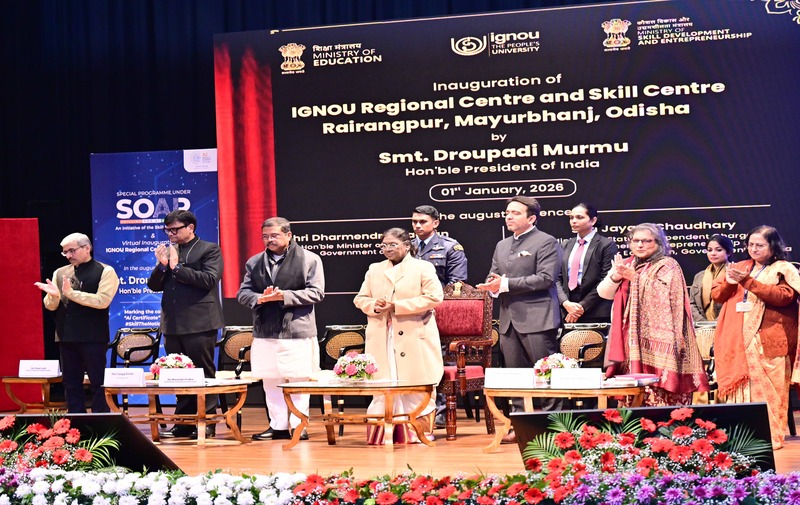
Alongside the AI challenge, President Murmu virtually inaugurated the IGNOU Regional Centre and Skill Centre at Rairangpur in Odisha. This inauguration holds deep symbolic and practical importance. Rairangpur is part of a region that represents India beyond metropolitan cities—areas where talent exists but opportunities are often limited. By expanding educational and skill infrastructure to such regions, the government is working to bridge long-standing social and economic gaps. Institutions like IGNOU play a critical role in democratizing education by reaching learners who may not have access to traditional universities. The new centers are expected to empower students, working professionals, and lifelong learners, helping them participate in India’s digital and AI-led growth story.
A key theme of the President’s address was inclusion. She emphasized that India’s approach to technology has always been people-centric. AI, she said, should be used to empower citizens, promote inclusion, and expand opportunities for all. Importantly, she highlighted the need to ensure that AI benefits reach people of all backgrounds and ages, especially those from marginalized communities. This vision aligns with India’s broader development philosophy, where technology is seen not as an end in itself but as a means to social progress. From improving access to healthcare and education to enhancing public service delivery, AI has the potential to reduce inequalities if guided by ethical and inclusive principles.
President Murmu expressed happiness at seeing students prepare themselves for a future filled with possibilities. Yet, her message went beyond technical skills. She urged young learners to remember that knowledge and technology must be used to serve society, solve real-world problems, and empower others.
In a noteworthy gesture, the President appreciated Members of Parliament who have completed AI learning modules. By engaging with emerging technologies themselves, she said, they have set an example of leadership through learning. This acknowledgment highlights an important truth: in a rapidly changing technological landscape, learning cannot be limited to classrooms or specific age groups. Policymakers, administrators, and leaders must also continuously update their knowledge to make informed decisions. Such an approach strengthens governance and ensures that technology policies remain grounded in understanding rather than fear or hype.
Looking ahead, President Murmu described AI as a major growth driver for India’s economy. In the coming decade, AI is expected to significantly contribute to GDP growth, employment generation, and productivity enhancement. As industries adopt automation and intelligent systems, demand for skilled professionals in AI-related fields will continue to rise. By investing in skilling today, India is laying the foundation for economic resilience tomorrow. The emphasis on collaboration between government, industry, academia, and institutions ensures that skill development remains relevant, practical, and aligned with real-world needs.
Concluding her address, the President urged all stakeholders to work together with commitment to build a developed India. She linked the AI skilling mission with the broader goals of the National Education Policy, envisioning India as a knowledge superpower. The launch of the #SkillTheNation AI Challenge and the inauguration of new education centers reflect a clear national intent: to build a tech-driven, inclusive, and prosperous India. At its heart, this initiative is not just about machines or algorithms but about people—students, workers, and communities who will shape India’s future in the age of Artificial Intelligence.

Writing about what truly matters, good news and stories to remind the world - it is brighter than we think.