"Dream, Dream, Dream! Conduct these dreams into thoughts, and then transform them into action."
- Dr. A. P. J. Abdul Kalam
"Dream, Dream, Dream! Conduct these dreams into thoughts, and then transform them into action."
- Dr. A. P. J. Abdul Kalam
9 Jan 2026
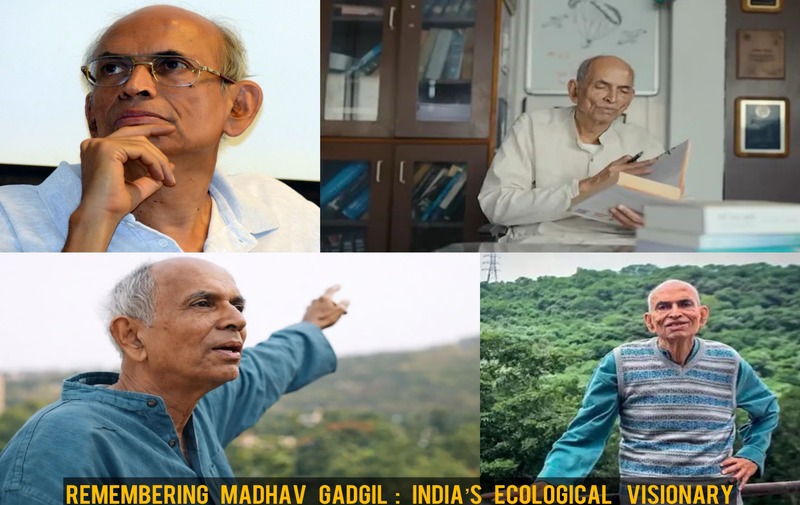
The passing of Dr. Madhav Dhananjaya Gadgil on January 7, 2026, marks the end of an era in Indian ecology, but not the end of his influence. A pre-eminent ecologist, institution builder, policy thinker, and people’s scientist, Gadgil was among the rare intellectuals who combined world-class scholarship with deep commitment to India’s land, forests, and communities. For over five decades, he stood at the intersection of science, society, and sustainability, shaping how India understands and protects its natural heritage.
Born on May 24, 1942, in Pune, Gadgil grew up in a household steeped in intellect and public service. His father, Dhananjay Ramchandra Gadgil, was a renowned economist and the architect of the Gadgil Formula, while his mother, Pramila, nurtured a spirit of curiosity and discipline. This environment laid the foundation for a life devoted not just to knowledge, but to its ethical use.
Gadgil’s academic journey began at Fergusson College, Pune, where he studied biology and also excelled as an athlete, holding state and university high jump records. He later completed his master’s degree in zoology from the University of Mumbai before moving to Harvard University, then one of the world’s most exciting centers for ecological and evolutionary biology.
At Harvard, he came under the influence of legendary biologist E. O. Wilson, often described as “Darwin’s heir.” Under the guidance of William H. Bossert, Gadgil pursued doctoral research in mathematical ecology and animal behavior, earning his PhD in 1969. He stayed on as a research fellow and lecturer, working at the Harvard Computing Center with support from an IBM Fellowship. A glittering international career lay open before him. Yet, unlike many of his peers, Gadgil made a choice that defined his life.
In 1971, Gadgil returned to India, driven by a clear conviction that meaningful science must serve society. After a brief stint at the Agharkar Research Institute in Pune, he joined the Indian Institute of Science (IISc), Bengaluru, in 1973. Over the next three decades, he transformed IISc into a global hub for ecological research by founding the Centre for Ecological Sciences, along with the Centre for Theoretical Studies. His work introduced quantitative methods into Indian ecology and, crucially, placed humans within ecosystems, not outside them.
For Gadgil, forests were not empty landscapes to be managed from above but living systems shaped by local communities, traditions, and knowledge. This human-centred ecological vision became his signature contribution.
Gadgil’s influence extended far beyond academia. In the late 1970s and 1980s, he played a pivotal role in landmark conservation efforts such as the Save Silent Valley Movement, helping prevent the destruction of one of India’s most precious rainforests. His research was instrumental in the declaration of the Nilgiris as India’s first biosphere reserve in 1986. He served on the Scientific Advisory Council to the Prime Minister, contributed to forest and biodiversity policy, and was deeply involved in shaping the Biological Diversity Act, 2002.
One of his most people-oriented initiatives was the People’s Biodiversity Register, a pioneering effort to document biodiversity using local knowledge, empowering communities as custodians of nature rather than passive stakeholders.
Perhaps Gadgil’s most widely known public role came in 2010, when he was appointed Chairman of the Western Ghats Ecology Expert Panel (WGEEP). The panel’s 2011 report recommended that nearly 64 percent of the Western Ghats be declared an Ecologically Sensitive Area. Written in a democratic, transparent, and scientifically rigorous manner, the report gave equal voice to ecology and livelihoods. While environmentalists hailed it as visionary, political resistance followed, leading to the formation of the Kasturirangan Committee, which diluted many of its recommendations. Yet, history increasingly recognizes the Gadgil Report as a document ahead of its time—one that warned India of the cost of ignoring ecological limits.
Beyond policy and research, Gadgil was a gifted communicator and mentor. He wrote columns, books, and essays that made complex ecological ideas accessible to the public. He believed deeply in people’s movements, local governance, and education as tools for conservation. His memoir, published in the final years of his life, reflects a rare blend of scientific clarity, humor, humility, and wisdom.
He shared his life with Sulochana Gadgil, a distinguished meteorologist and scholar, whose passing in 2025 deeply affected him. He is survived by their son, a mathematician, and their daughter, a journalist and Spanish teacher,
Gadgil’s contributions were recognized globally, with honors including the Padma Shri, Padma Bhushan, Shanti Swarup Bhatnagar Prize, Volvo Environment Prize, Tyler Prize for Environmental Achievement, and the United Nations Champions of the Earth Award (2024). Yet, those who knew him say his greatest reward was seeing science shape society for the better.
Madhav Gadgil’s life was devoted to scholarship in its noblest sense, rooted in truth, guided by ethics, and animated by compassion. He showed India that protecting nature is not anti-development but essential to a just and sustainable future. Long after his passing, his ideas will continue to walk through forests, classrooms, village councils, and policy debates. In remembering him, we are reminded that some lives do not merely end—they become part of the landscape they worked to protect.
Lessons from a Life Lived for Nature and People
The life of Madhav Dhananjaya Gadgil teaches us that true greatness lies in choosing responsibility over recognition. Despite global opportunities, he returned to India to build institutions, mentor students, and serve society through science. His work reminds us that development must respect ecological limits and include local communities as equal partners. Gadgil showed that knowledge is most powerful when it is shared, democratic, and rooted in ethics. Above all, his life teaches us courage—the courage to speak scientific truth to power, to stand by principles despite opposition, and to dedicate one’s intellect to the greater good of humanity and nature.

Writing about what truly matters, good news and stories to remind the world - it is brighter than we think.